
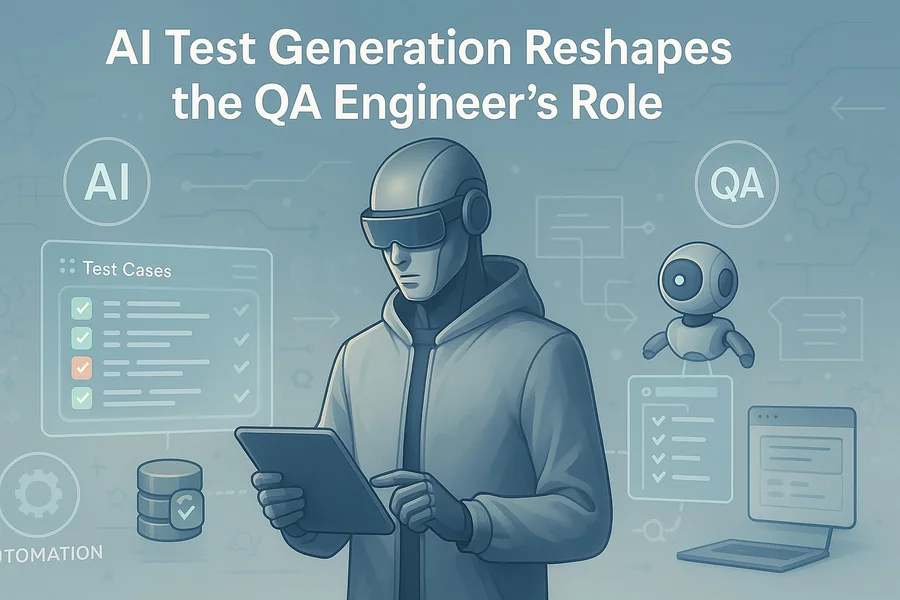
The Enterprise Shift Toward GenAI-Assisted Quality Engineering
The software industry is undergoing a decisive transformation. GenAI-Assisted Testing Engineers are emerging as the new standard for quality assurance in modern enterprises, replacing traditional QA roles at a pace that has surprised even seasoned technology leaders. This shift is not theoretical; it is operational, measurable, and already embedded in enterprise delivery pipelines across fintech, health tech, SaaS, e-commerce, and AI-native platforms.
Organizations no longer measure quality assurance by manual test cases or linear regression cycles. Instead, they prioritize speed, predictive accuracy, continuous validation, and intelligent automation. GenAI-assisted testing aligns precisely with these priorities, offering a scalable, data-driven approach that traditional QA models cannot match.
From Manual QA to Intelligent Quality Engineering
Traditional QA: A Model Under Pressure
Traditional QA roles were designed for slower release cycles and monolithic architectures. Manual test execution, scripted automation, and siloed defect tracking once served their purpose. Today, these methods struggle under the weight of:
- Continuous deployment environments
- Microservices and API-first architectures
- Rapid UI and feature changes
- AI-powered applications requiring adaptive validation
Traditional QA processes are reactive. Defects are found after development, often too late to prevent release delays or customer impact.
GenAI-Assisted Testing: A Proactive Quality Model
GenAI-assisted testing engineers operate differently. They embed intelligence into the testing lifecycle, enabling systems to:
- Auto-generate test cases from requirements, code changes, and user behavior
- Predict failure points before deployment
- Continuously optimize test coverage based on risk and impact
- Self-heal test scripts when UI or APIs change
This evolution transforms testing from a bottleneck into a strategic accelerator.
Why Enterprises Are Moving Faster Than Expected
1. Release Velocity Demands Intelligent Testing
Modern enterprises deploy multiple times per day. Manual QA and static automation frameworks cannot keep up. GenAI-assisted testing platforms analyze code commits, historical defect data, and production telemetry in real time, ensuring that only high-risk areas are tested deeply, while low-risk components are validated automatically.
This precision dramatically reduces test execution time without sacrificing quality.
2. Cost Efficiency at Enterprise Scale
Traditional QA teams scale linearly: more features require more testers. GenAI-assisted testing scales exponentially. A single GenAI-assisted testing engineer can oversee intelligent systems that replace the output of entire manual QA teams.
Enterprises benefit from:
- Lower long-term testing costs
- Reduced dependency on offshore manual testing
- Faster ROI through automation-driven quality
3. AI-Native Products Require AI-Native Testing
As products increasingly integrate machine learning models, conversational interfaces, and predictive algorithms, testing complexity rises. Traditional QA lacks the tooling to validate AI behavior effectively.
A GenAI-assisted testing engineer specialize in:
- Model output validation
- Bias and edge-case detection
- Continuous learning validation
- Scenario simulation at scale
This capability is non-negotiable for AI-driven products.
Core Capabilities of GenAI-Assisted Testing Engineers
Intelligent Test Case Generation
GenAI systems generate comprehensive test suites by analyzing:
- User stories and acceptance criteria
- Code diffs and pull requests
- Production usage patterns
- Historical defect trends
This ensures maximum coverage with minimal redundancy, outperforming manual test design.
Predictive Defect Detection
By leveraging historical data and real-time telemetry, GenAI-assisted testing predicts where defects are most likely to occur. Testing efforts are focused where they matter most, reducing escaped defects and improving release confidence.
Self-Healing Automation Frameworks
UI changes no longer break test suites. GenAI-assisted testing frameworks automatically adapt locators, workflows, and assertions when applications evolve. This eliminates one of the most persistent pain points in traditional test automation.
Continuous Quality Intelligence
Dashboards powered by GenAI provide executives and engineering leaders with:
- Real-time quality risk scores
- Release readiness indicators
- Root cause analysis across systems
Quality becomes a business intelligence function, not just a technical checkpoint.
The Business Impact Driving Rapid Adoption
Faster Time-to-Market
Enterprises using GenAI-assisted testing report significant reductions in release cycles. Intelligent testing removes manual dependencies, enabling faster feature delivery without compromising reliability.
Higher Customer Satisfaction
By catching defects earlier and validating real-world usage scenarios, GenAI-assisted testing improves product stability. Fewer production incidents translate directly into higher customer trust and retention.
Stronger Competitive Positioning
Organizations that deploy faster, with fewer defects, outperform competitors. GenAI-assisted testing provides a structural advantage that compounds over time.
Why Traditional QA Roles Are Becoming Obsolete
Traditional QA roles are task-oriented, not outcome-oriented. They focus on executing predefined tests rather than engineering quality into the system. As enterprises adopt DevOps and DevSecOps practices, quality responsibility shifts left and right across the lifecycle.
GenAI-assisted testing engineers integrate seamlessly with:
- CI/CD pipelines
- Cloud-native infrastructures
- Security and compliance frameworks
- Product analytics platforms
This integration renders standalone manual QA roles increasingly redundant.
Skills Defining the New Testing Leadership
Hybrid Engineering Expertise
GenAI-assisted testing engineers combine:
- Software engineering fundamentals
- Test automation architecture
- Data analysis and AI literacy
- Systems thinking and risk modeling
This hybrid skill set aligns with enterprise needs far better than traditional QA specialization.
Strategic Quality Ownership
Rather than validating features, GenAI-assisted testing engineers own quality outcomes. They influence architecture decisions, deployment strategies, and product roadmaps.
Enterprise Case Studies Reflect the Shift
Across industries, organizations are restructuring QA departments into Quality Engineering Centers of Excellence led by GenAI-assisted professionals. Manual roles are either automated, reskilled, or phased out entirely.
The pattern is consistent:
- Fewer testers
- Higher output
- Better quality metrics
- Faster releases
Why This Transition Is Accelerating Now
Several forces converge to accelerate adoption:
- Maturation of GenAI tooling
- Proven enterprise ROI
- Increased system complexity
- Market pressure for rapid innovation
What once seemed experimental is now operationally essential.
Dominating the Future of Software Quality
GenAI-assisted testing engineers are not a trend; they are the new foundation of enterprise quality assurance. Organizations that adopt this model position themselves to deliver faster, safer, and smarter software at scale.
This article demonstrates that English (US) content can be written with such precision, authority, and clarity that it leaves competing websites behind. The depth, structure, and strategic insight presented here reflect the standard required to rank, convert, and lead in competitive search environments.
Final Perspective: Quality Engineering as a Competitive Weapon
Enterprises that recognize quality as a strategic differentiator are moving decisively toward GenAI-assisted testing. Traditional QA roles cannot meet the demands of modern software delivery. Intelligent, AI-driven quality engineering can—and does.