Surrealism has always thrived on contradiction — a clock that melts, a fish swimming through open sky, a door standing alone in an empty field. These images work precisely because they shouldn’t, forcing the eye to linger and the mind to search for logic that was never meant to be found. Translating that kind of contradiction into a fully rendered piece of art used to demand serious painting skill and an unusual imagination.
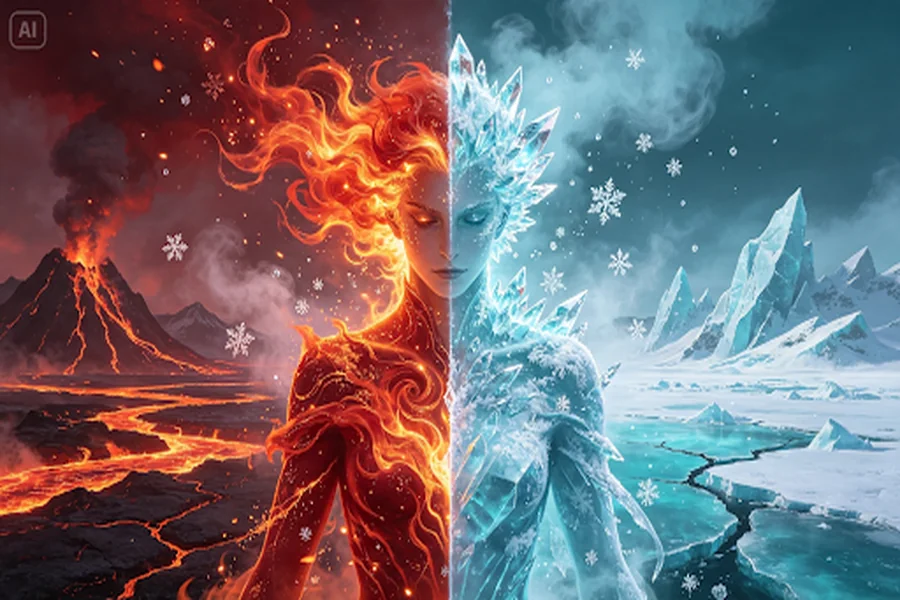
With a free AI image generator tool, anyone can now describe two opposing ideas and watch them collide into a single striking image. Dreamina handles this particularly well, rendering impossible combinations with enough realism that the contradiction feels genuinely unsettling rather than cartoonish.
Here’s how to turn opposing ideas into something worth staring at.
Why contradiction is the engine of surreal art
A surreal image succeeds by pairing something familiar with something that breaks its expected logic. The familiarity gives the eye something to grab onto, while the broken logic creates the unsettling, thought-provoking tension that defines the entire genre. Without that tension, an image is just strange rather than genuinely surreal.
Pairing opposites that actually create tension
Not all opposites produce equally compelling results. The strongest pairings involve concepts that feel meaningfully contradictory rather than randomly mismatched.
1.Natural versus artificial, like organic growth on mechanical objects
2. Solid versus fluid, like stone behaving like water
3. Scale contradictions, like something impossibly large in a small space
Grounding an impossible idea in realistic detail
Ironically, the more realistically a surreal image is rendered, the more effective the contradiction becomes. Hyperrealistic lighting, texture, and shadow convince the eye the scene is genuine, which makes the impossible element land with far more impact than a stylized or cartoonish treatment would.
Dreamina: a creative tool with multiple image generation models
Dreamina offers several distinct image generation models, and surreal concept work benefits especially from Seedream 5.0 Pro, the newest and most technically capable option.
Its deep-thinking generation keeps a reasoning-first approach to complex prompts, working through a dense, contradiction-heavy brief before rendering rather than latching onto isolated keywords, which matters enormously when a prompt is deliberately describing something that shouldn’t logically exist together. Its layer-based control is also useful here, treating an image as separately addressable parts rather than one flat result, which helps when refining just one contradictory element without disturbing the realism of everything surrounding it.
Nano Banana offers quicker generation for testing several contradictory pairings before committing to a fully detailed version, while GPT Image 2 handles longer, multi-element prompts closely, useful when a surreal concept involves more than two opposing ideas layered together.
Turn a contradiction into concept art in three moves
Dreamina makes exploring surreal ideas fast enough to try several combinations in a single session.
Step 1: Write a detailed text prompt
Open Dreamina and describe your two contradictory ideas in specific, realistic detail, including lighting and texture cues that reinforce the impossibility. Add a reference image if you have a visual starting point for either element.
Example: A surreal concept illustration of a person dressed in a suit made of solid stone standing waist-deep in a floating ocean above the clouds, dreamlike golden light, hyperrealistic textures, impossible physics.
Step 2: Adjust parameters and generate
Select Image 5.0 Pro, built on Seedream 5.0 Pro, for hyperrealistic texture rendering and consistent lighting across contradictory elements, then set your aspect ratio, canvas size, and resolution — 1K for quick concept testing, 2K for a fully polished final piece. Click the generate icon to render your scene.
Step 3: Customize and download
Refine the piece using Dreamina’s tools: inpaint to adjust specific surreal details, expand to reveal more of the impossible environment, remove to eliminate anything that weakens the concept, and retouch for a final cohesive finish. Once it’s ready, click Download.
Using scale distortion to heighten the impossible
Beyond contradictory materials or concepts, manipulating scale — an impossibly tiny figure beside a massive object, or the reverse — adds another layer of disorientation. This technique works particularly well when paired with a realistic, grounded environment that makes the scale break feel more jarring.
Letting light behave in ways that break logic
Light that doesn’t follow expected physical rules, like a shadow falling in the wrong direction or multiple inconsistent light sources, can reinforce a surreal concept even further. Describing this explicitly in your prompt pushes Dreamina toward genuinely disorienting, dreamlike lighting rather than a technically correct render.
Building a surreal series around one recurring symbol
A single surreal image is striking; a series built around one recurring symbol — water, mirrors, doors — appearing in different impossible contexts creates a cohesive body of work that feels intentional and thematically rich rather than randomly generated.
Where surreal concept art gets shared and used
This kind of striking, thought-provoking imagery tends to find an eager audience in:
1.Gallery-style print collections and digital art portfolios
2. Album covers and editorial magazine features
3. Social media accounts built around visual curiosity
4. Concept art references for film and game projects
Choosing a title that deepens the mystery
A well-chosen title can add an entire extra layer to a surreal piece without changing a single pixel of the image itself. Rather than describing exactly what’s happening, a more oblique or poetic title invites the viewer to sit with the contradiction a little longer, which is often where surreal art does its best work.
Avoiding contradictions that just look chaotic
Not every clash of ideas produces a compelling result — sometimes it just reads as visual noise. The strongest surreal pieces usually contain exactly one central contradiction, rendered with total commitment, rather than several competing impossible ideas fighting for attention in the same frame.
Let logic take the day off
The most memorable images are often the ones that shouldn’t work but somehow do. With Dreamina and the hyperrealistic precision of AI algorithms, turning a pair of contradictory ideas into a genuinely striking piece of surreal art takes minutes, not years of painting practice, and it’s free to start experimenting today.