That’s when you realize tourmaline isn’t really a one-color gemstone at all.
Its unusually broad color range is one of the reasons tourmaline works so well in distinctive fine jewelry. Instead of choosing a design first and simply adding a gemstone, buyers can select a tourmaline based on its individual color, color zoning, shape, and personality—and build the jewelry around it.
For anyone considering a tourmaline ring, understanding the different varieties, durability, symbolism, and setting options makes choosing the right stone much easier.
What Is Tourmaline?
Tourmaline isn’t a single mineral. It belongs to a group of related minerals with similar crystal structures and varying chemical compositions.
Those differences contribute to tourmaline’s remarkable range of colors.
Depending on the stone, tourmaline can appear:
- Pink
- Green
- Blue
- Red
- Yellow
- Peach
- Brown
- Black
- Bi-color
- Multi-color
Some crystals contain more than one distinct color.
This natural variation means two tourmaline rings can use the same gemstone family while looking completely different.
Why Does Tourmaline Come in So Many Colors?
Tourmaline is one of those gemstones where the color can vary a lot from one stone to another. Its color is influenced by its chemical composition and the trace elements present as the crystal forms, which can result in everything from soft pastel shades to deeper greens, pinks, and blues.
Tourmaline can also show color zoning within a single crystal, meaning you may see more than one color in the same gemstone.
Rather than treating that variation as something to hide, jewelry designers can make it part of the design. This is especially interesting with bi-color and watermelon tourmaline, where the different colors are part of what makes the stone so distinctive.
Pink Tourmaline Rings
Pink tourmaline can range from barely-there blush tones to much deeper pink and reddish shades, which makes it a pretty versatile gemstone for jewelry.
A pale pink tourmaline can give an engagement ring a softer, more understated look, while a more saturated stone can easily become the main feature of the design.
Pink tourmaline also works well with different metals and settings. It can be paired with yellow gold, rose gold, or white gold, as well as diamond accents, minimalist settings, or vintage-inspired designs.
If you love pink gemstones but don’t want the most predictable bridal option, a pink tourmaline engagement ring gives you plenty of room to do something a little different.
Green Tourmaline Rings
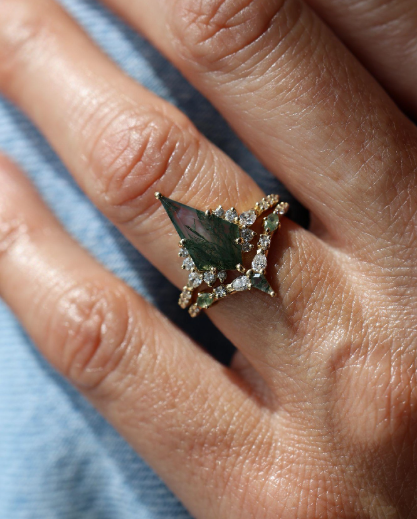
Green tourmaline comes in a pretty wide range of shades. Some stones are light and fresh, while others have much deeper forest green tones. Depending on the individual gemstone and the lighting, you may also notice yellow or blue undertones.
Green tourmaline works especially well with nature-inspired and botanical engagement rings, but it can also look great in geometric designs, yellow gold settings, and rings with diamond accents.
If you love green gemstones but want something different from a traditional emerald, green tourmaline is worth considering. It has its own look while still giving you that rich green color you’re drawn to.
Blue Tourmaline
Blue tourmaline is often associated with the variety known as indicolite.
Colors can range from lighter blue to deeper blue-green shades.
Because attractive blue tourmaline can be less commonly encountered than pink or green material, individual stones can become the central feature of a design rather than simply another interchangeable gemstone.
Blue and blue-green tourmalines work particularly well in modern rings where color is intended to be the primary visual element.
What Is Watermelon Tourmaline?
Watermelon tourmaline is one of the gemstone family’s most recognizable color combinations.
As the name suggests, the crystal can display pink or reddish color together with green, sometimes with lighter material separating the two.
And yes, somebody looked at the stone and apparently decided, “That looks like lunch.”
The name stuck.
When cut to preserve its natural color zoning, watermelon tourmaline can produce highly individual jewelry.
Rather than seeking perfectly uniform color, the design can emphasize the transition between shades.
This makes it particularly interesting for buyers who want a gemstone that doesn’t look standardized.
What Is Bi-Color Tourmaline?
Bi-color tourmaline contains two visibly different colors within the same gemstone.
The transition might be subtle or strongly defined.
For jewelry designers, that creates an additional decision: how should the stone be oriented?
A horizontal setting might emphasize the color transition differently from a vertical one.
An asymmetrical design can respond to the distribution of color within the specific gemstone.
This is a good example of why some jewelry is better designed around the stone rather than forcing every stone into the same predetermined setting.
What Does Tourmaline Symbolize?
Gemstone symbolism can vary quite a bit depending on the culture and tradition, so it’s worth remembering that these meanings are not scientifically established properties of the stone.
In modern jewelry, tourmaline is often associated with ideas like creativity, individuality, emotional connection, balance, protection, and love. Different colors can also have their own traditional associations.
Pink tourmaline is often connected with love and emotional expression, while green tourmaline can be associated with nature, growth, and renewal.
But honestly, the most meaningful interpretation is usually the personal one. A certain color might remind you of a favorite place, a childhood memory, a birth month, or simply be a color you’ve always loved.
That’s part of what makes choosing a colored gemstone for an engagement ring so personal. The meaning doesn’t have to come from a traditional gemstone guide. It can come from you.
Is Tourmaline a Birthstone?
Yes. Tourmaline is one of the birthstones associated with October, alongside opal.
Its wide range of colors makes it particularly useful for birthstone jewelry because buyers aren’t restricted to a single traditional color.
An October birthday gift could therefore feature pink, green, blue, or multi-color tourmaline depending on the recipient’s preferences.
Is Tourmaline Durable Enough for Rings?
Tourmaline generally ranks around 7 to 7.5 on the Mohs hardness scale.
That makes it suitable for many types of jewelry, including rings, but it isn’t as resistant to scratching as diamond or sapphire.
This distinction matters because rings typically experience more impacts and surface contact than earrings or necklaces.
A tourmaline ring intended for frequent wear should therefore be chosen with attention to:
- Setting protection
- Exposed corners
- Stone shape
- Setting height
- Wearer’s lifestyle
Removing the ring during activities such as heavy exercise, gardening, manual work, or household cleaning can help reduce unnecessary risk.
For independent gemological information about tourmaline and other colored stones, the Gemological Institute of America (GIA) provides educational information about tourmaline’s characteristics, sources, colors, and quality factors.
Which Tourmaline Ring Styles Work Best?
Tourmaline’s color variety makes it unusually adaptable.
Solitaire Tourmaline Rings
A solitaire allows the gemstone’s color to become the main feature.
This can work particularly well with stones that already have strong color zoning or an unusual shape.
Diamond Halo Rings
Small diamonds around a colored tourmaline create contrast and emphasize the center stone.
This approach works with pink, green, blue, and bi-color varieties.
Three-Stone Rings
Tourmaline can be paired with diamonds or other colored gemstones.
Side stones can either contrast with the center stone or repeat one of its colors.
Nature-Inspired Rings
Green and watermelon tourmalines naturally lend themselves to botanical and organic designs.
Leaves, branches, flowers, and curved settings can reinforce the gemstone’s color without overwhelming it.
Minimalist Rings
An unusual gemstone doesn’t require an elaborate setting.
A simple tourmaline ring can place the focus entirely on the stone’s individual color, cut, and natural variation.
Which Metal Looks Best With Tourmaline?
There isn’t one correct combination.
The choice depends largely on the particular stone.
Yellow Gold
Yellow gold creates warm contrast and works especially well with many green, pink, and peach tourmalines.
Rose Gold
Rose gold can complement pink and warm-toned tourmalines, creating a more tonal combination.
White Gold
White gold provides a relatively neutral background that allows the gemstone color to dominate.
Platinum
Platinum also creates a neutral white-metal setting and can be used when the design calls for that appearance and material.
Because tourmaline varies so much, it’s useful to compare the actual gemstone against different metals rather than making the decision based only on its color category.
Tourmaline and Custom Jewelry
Tourmaline can be especially interesting for custom jewelry because no two stones necessarily look exactly alike.
Imagine finding a bi-color tourmaline with green on one side and pink on the other. A standard setting might simply be designed to hold the stone, but a custom design can actually work around what makes that particular gemstone interesting.
The jeweler might adjust the stone’s orientation, prong placement, side stones, band shape, metal color, or decorative details to suit the individual gemstone.
The idea is to make the stone part of the design rather than treating it like a component that could be swapped for any other gemstone.
That’s one reason tourmaline can be such a good choice for custom engagement rings. If you don’t want your jewelry to look exactly like someone else’s, starting with a gemstone that already has its own natural variations gives the design somewhere interesting to begin.
Tourmaline vs Sapphire
Tourmaline and sapphire both offer extensive color choices, but they have different physical properties.
Sapphire ranks 9 on the Mohs scale, while tourmaline is approximately 7 to 7.5.
For someone prioritizing resistance to scratching in an everyday ring, sapphire therefore has an advantage.
Tourmaline, however, offers distinctive bi-color and multi-color possibilities that can be difficult to reproduce with other gemstones.
The choice depends on what matters more: maximum everyday durability, a specific color, natural color zoning, or an individual stone.
Tourmaline vs Emerald
Green tourmaline and emerald can sometimes appeal to the same buyer, but they’re visually different gemstones.
Emerald is associated with its characteristic green color and often-visible inclusions.
Green tourmaline can occur across a broader range of green shades and may display different clarity characteristics.
Rather than asking which is objectively better, compare the actual stones.
Color preference often makes the decision surprisingly easy.
How Should You Care for a Tourmaline Ring?
Tourmaline jewelry should be treated thoughtfully, particularly when worn frequently.
For routine cleaning, mild soap, lukewarm water, and a soft brush are generally appropriate.
Avoid exposing the jewelry unnecessarily to:
- Hard impacts
- Abrasive materials
- Harsh chemicals
- Sudden temperature changes
Professional inspection can also help identify loose prongs or setting issues before a gemstone is lost.
Always follow care guidance appropriate to the specific stone and setting.
How to Choose a Tourmaline Ring
Start with color.
Ask yourself whether you’re drawn to pink, green, blue, bi-color, watermelon, or another variety.
Then consider:
Stone: Do you like the actual individual gemstone?
Color: Is the shade attractive in different lighting?
Shape: Does the cut suit your preferred jewelry style?
Setting: Is the stone adequately protected?
Metal: Does it complement the gemstone?
Lifestyle: Is the design practical for how often you’ll wear it?
Craftsmanship: Is the gemstone securely and appropriately set?
With naturally variable gemstones, choosing the individual stone can matter as much as choosing the ring design.
Frequently Asked Questions
What colors does tourmaline come in?
Tourmaline occurs in a wide variety of colors, including pink, green, blue, red, yellow, peach, brown, and black. Individual crystals can also contain two or more colors.
What is watermelon tourmaline?
Watermelon tourmaline displays pink or reddish and green color zones within the same crystal, creating an appearance reminiscent of a watermelon.
Is tourmaline good for everyday rings?
Tourmaline can be worn in rings, but with a Mohs hardness of approximately 7 to 7.5, it requires more care than harder gemstones such as diamond or sapphire. A protective setting and appropriate wearing habits can reduce unnecessary damage.
What does a tourmaline ring symbolize?
Tourmaline is commonly associated in modern gemstone symbolism with individuality, creativity, love, balance, and protection. Symbolic meanings aren’t scientific properties and can vary by culture and tradition.
Is tourmaline suitable for an engagement ring?
Yes, tourmaline can be used for an engagement ring, particularly for someone who values color and individuality. Because it’s softer than sapphire or diamond, setting choice, lifestyle, and care should be considered for frequent wear.
Final Thoughts
Tourmaline’s biggest strength is that it’s difficult to reduce to one look.
A pale pink tourmaline can feel delicate. A deep green stone can create an entirely different ring. Blue tourmaline can become the focal point of a minimalist design, while watermelon and bi-color stones can turn natural color zoning into the defining feature.
That variety gives designers and buyers room to do something more interesting than simply choose a gemstone from a list.
With tourmaline, the individual stone can help determine the design around it.
And for jewelry intended to feel personal rather than standardized, that’s exactly what makes the gemstone worth exploring.