
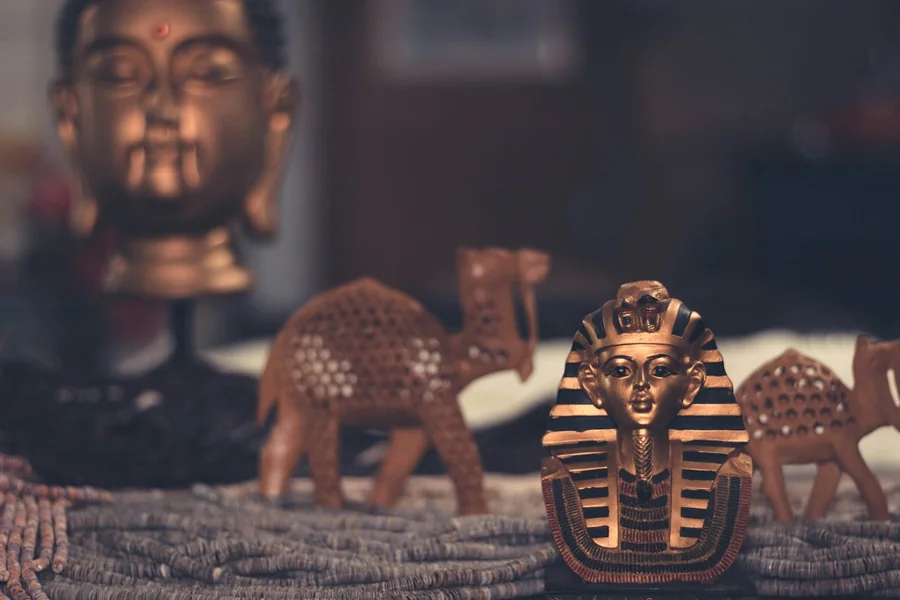

If you have played Tomb Raider: The Last Revelation, you know that it was not an easy task for Lara Croft to navigate through these Egyptian tombs. There were secret chambers to uncover, riddles to solve, and traps in almost every place. Naturally, the actual tombs of ancient Egypt had a completely different function. They were constructed for burial and religious rites, not for adventures.
Nevertheless, it is not surprising that ancient Egypt is repeatedly used in video games as a source of inspiration for creators. Some game producers develop whole game environments based on the history and mythology of Egypt, while others use some recognizable icons.
Ancient Egypt Has a Look That’s Hard to Mistake
Just put a pyramid, add some palm trees and a giant statue of stone and most gamers will recognize Egyptian theme instantly. People who don’t know much about its history will be able to recognize a sphinx or walls decorated with hieroglyphs. This makes ancient Egypt a very recognizable theme for video games.
Some details can give hints on what to do and where to find something important. For example, a door carved into rock might indicate something valuable inside, whereas a symbol of a scarab beetle could be a clue. Obelisks can make any fictional city look more believable, showing how historical symbols are used in gaming.
Game developers have great freedom when choosing their interpretation of ancient Egypt. Architecture, arts and religious beliefs of Egyptians changed dramatically during thousands of years and developers often mix them. Therefore, Egyptian-themed game looks very nice but is not always historically accurate.
Why Exploring an Egyptian Tomb Is So Much Fun
You search a room, try the same door repeatedly and eventually spot the lever you missed beside a statue. Egyptian tombs and temples offer plenty of inspiration for these moments, with narrow passages, decorated walls and hidden chambers that developers can turn into puzzles.
Released in 1999, Tomb Raider: The Last Revelation is a good example of this approach. Lara Croft explores Egyptian ruins filled with ancient structures, elaborate puzzles and supernatural dangers. The game draws on Egyptian mythology to create a fictional adventure centered on exploration.
Egyptian tombs were designed for burial and religious purposes. Some of the tombs had hidden entrances and closed pathways. The game Tomb Raider is based on these historical features, and they have been made into mechanical traps, puzzles, and supernatural events.
The Gods Have Their Own Stories
Egyptian mythology is yet another good source of ideas for video game creators. Egyptians worshipped gods of the sun, of death, of protection, and many others. Some of these gods were also unique-looking enough to be easily recognizable even nowadays.
Anubis is a good example of such gods. The jackal-headed god is known even by people unfamiliar with ancient Egyptian religion. He was connected with embalming and other funerary practices in the religion.
There is Osiris, a popular god in the tradition of death and afterlife. Their myths have evolved over many years, and their role in Egyptian religion was much more complicated than what you see in the video games. Traditions have been simplified and adapted by the creators of the games. In the game Tomb Raider: The Last Revelation, Set becomes the key player in the supernatural struggle against Lara Croft.
You Don’t Need a Huge Adventure to Borrow the Theme
Not every Egyptian-inspired game needs an enormous map or a complicated story. Sometimes the influence appears through smaller design choices, from familiar symbols to decorative elements that help establish a recognizable setting.
Developers can incorporate Egyptian imagery in several ways:
- Puzzle elements: Hieroglyph-inspired symbols and scarabs can serve as clues or interactive objects.
- Visual design: Colors inspired by Egyptian wall paintings can influence backgrounds and game environments.
- Architecture: Pyramids, obelisks and statues can help establish a recognizable historical theme.
- Different gaming formats: The Mo Mummy slot shows how Egyptian imagery can also appear in another type of digital game.
These familiar elements make Egyptian-inspired games easy to recognize, while the civilization’s broader history offers opportunities for even more varied settings and stories. There’s far more to Egyptian history than pyramids and hidden treasure, giving developers plenty of material beyond the usual imagery.
Assassin’s Creed Took a Different Approach
Assassin’s Creed Origins offers a different experience from the fantastical tomb exploration of Tomb Raider. Set during the Ptolemaic period in the first century BCE, the game depicts an Egypt with thousands of years of history. The Great Pyramid of Giza was already roughly 2,500 years old.
Players can travel along the Nile, explore settlements and discover locations inspired by historical Egypt. Although the main storyline is fictional, the developers put considerable effort into recreating the period’s landscapes and architecture, giving players a sense of what life might have looked like.
One particularly interesting addition was Discovery Tour: Ancient Egypt, an educational mode that allows players to explore the environment through guided historical tours. Rather than completing missions or fighting enemies, they can focus on learning about the buildings, traditions and places featured throughout the game.
Someone might spend hours playing Origins for its story, then return to explore the historical details they encountered along the way. While the game isn’t a completely accurate reconstruction of ancient Egypt, it shows how interactive entertainment can encourage curiosity about the past.
Old Settings, New Possibilities
When an Egyptian-themed game that was created in the late 1990s is compared to an open-world adventure game created today, it becomes apparent just how different the visuals are. In the past, games used to have smaller environments as well as simpler character designs.
Beyond improved graphics, Egyptian history offers plenty of possibilities for new settings and stories:
- Ancient cities: Busy streets, markets and residential areas can provide settings beyond familiar monuments.
- Farming communities: Life along the Nile offers inspiration for stories about agriculture and everyday routines.
- Workshops and trade: Craftspeople, merchants and trading networks can introduce different characters and activities.
Better graphics have changed how these worlds look, but exploring unfamiliar places remains part of their appeal. These historical details give developers opportunities to create experiences that go beyond another expedition into a mysterious tomb.
Ancient History on a Modern Screen
The ancient Egyptians still have lots to offer when it comes to inspiration for modern games. While some of them are based on the myths of Egypt, others try to recreate the periods from the history of that civilization or use the elements of culture that can be recognized by many people. This demonstrates how much creativity there is in the ancient world.