
Businesses are consuming more network resources as cloud platforms, hosting services, data centers, AI infrastructure, and digital applications continue to expand. Yet one essential internet resource remains limited: public IPv4 addresses.
The supply of freely available IPv4 address space has largely been exhausted. Regional Internet Registries have therefore moved into a post-exhaustion environment in which organizations increasingly depend on transfers, existing holdings, IPv6 deployment, address-sharing technologies, or commercial access to IPv4 resources.
For organizations that need additional public IPv4 capacity but do not want to purchase address space outright, IP leasing provides another option.
Businesses can lease IP addresses for a defined period and use the address space for legitimate network operations without making the larger upfront investment normally associated with purchasing IPv4 assets.
But successful IPv4 leasing involves more than finding an available block. Routing, reputation, reverse DNS, authorization, geolocation, renewal terms, and provider structure can all influence whether the addresses work reliably in production.
What Is IP Leasing?
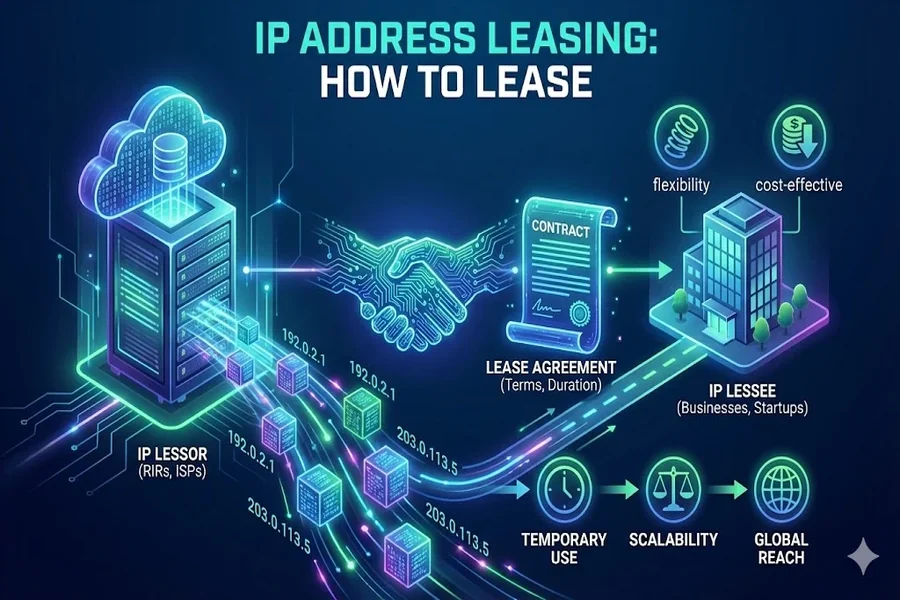
IP leasing is an arrangement in which an organization receives the right to use IP address space for a specified period without permanently acquiring ownership of the addresses.
In commercial networking, the term most commonly refers to IPv4 leasing.
A business may lease a /24, /23, /22, or larger IPv4 block depending on its infrastructure requirements. The addresses can then support applications such as:
- Cloud infrastructure
- Dedicated servers
- Web hosting
- Internet service providers
- Data centers
- SaaS platforms
- Enterprise networks
- VPN infrastructure
- Content delivery
- AI and GPU cloud environments
The fundamental difference between leasing and buying is straightforward.
When businesses buy IPv4 addresses, they acquire the resource through a permanent transaction subject to the relevant registry and transfer processes.
When businesses lease IP addresses, they obtain contractual usage rights while the underlying resource remains with the provider or address holder.
That distinction can make IP leasing attractive to organizations prioritizing flexibility and capital efficiency.
Why Do Businesses Lease IP Addresses?
1. IPv4 Addresses Are Scarce
IPv4 was designed with a finite address space. The available pool of addresses that could simply be distributed to organizations has been exhausted over time.
For example, ARIN announced depletion of its IPv4 free pool in September 2015, while RIPE NCC announced in November 2019 that it had made its final /22 allocation from its remaining IPv4 pool.
IPv6 provides vastly more addresses, but IPv4 connectivity remains important across many existing networks and internet services.
As a result, organizations expanding IPv4-dependent infrastructure must determine how they will obtain the additional address space they need.
2. Leasing Reduces Upfront Capital Requirements
Buying IPv4 address space can require substantial upfront expenditure.
That may be appropriate for organizations seeking long-term asset ownership, but not every network needs to permanently acquire its addresses.
With IP leasing, the organization typically pays for access over an agreed period rather than purchasing the entire block.
This can turn a large capital expense into a more predictable operating expense.
For fast-growing businesses, that capital can remain available for servers, bandwidth, network equipment, data-center capacity, software development, or geographic expansion.
3. Networks Can Scale More Flexibly
Demand for IP addresses is not always predictable.
A hosting company might add thousands of servers. An ISP may enter a new market. A cloud platform could experience rapid customer growth. An AI infrastructure provider may need to deploy additional capacity across several data centers.
Purchasing IPv4 every time capacity changes may not be the most flexible approach.
The ability to lease IPv4 addresses can give network operators another way to align address capacity with actual business demand.
4. Leasing Can Support Market Expansion
Network expansion frequently involves more than installing additional hardware.
Businesses may require routable public IP address space before launching infrastructure in a new region or supporting additional customers.
Leased IPv4 can provide the address capacity necessary for that deployment without requiring the business to make a permanent acquisition each time it enters a new market.
IP Leasing vs Buying IPv4 Addresses
Neither option is automatically better.
The right decision depends on the organization’s financial strategy, expected duration of use, growth plans, operational requirements, and appetite for ownership.
Buying IPv4 may make sense when:
- The addresses will be needed for many years.
- The organization wants permanent control of the asset.
- Sufficient capital is available.
- Long-term ownership is strategically important.
IP leasing may make sense when:
- The business wants lower upfront costs.
- Address demand may increase or decrease.
- Infrastructure is expanding rapidly.
- The requirement is temporary or medium-term.
- The organization prefers operational flexibility over permanent ownership.
Some companies also use both approaches. They own a core pool of IPv4 resources while leasing additional capacity as demand changes.
What Should You Check Before You Lease IP Addresses?
The quality of an IP lease should not be evaluated solely on price.
IPv4 addresses become part of production infrastructure, meaning problems with the address block can affect customers, applications, routing, email, hosting, and service availability.
Before businesses lease IP addresses, they should evaluate several factors.
IP Reputation
An IPv4 block may have been used previously.
That history matters.
Addresses associated with spam, malicious activity, botnets, or other abuse can develop poor reputation across security and filtering systems.
Businesses should therefore investigate address history and reputation before putting leased IPv4 into production.
Reputation is particularly important for hosting providers, cloud platforms, email infrastructure, and customer-facing applications.
Routing and BGP Readiness
Possessing permission to use an IPv4 block is not enough.
The addresses must also be correctly routed.
Organizations using their own ASN may need the appropriate authorization to announce the prefix through BGP. Routing documentation and provider support should therefore be clarified before deployment.
A leasing arrangement that fails to account for routing can result in an address block that exists contractually but cannot be deployed effectively.
RPKI and ROA
Route Origin Authorization can help network operators specify which Autonomous System is authorized to originate a particular IP prefix.
For organizations announcing leased IPv4 through their own networks, understanding the RPKI and ROA process can help reduce routing problems and prevent accidental invalid announcements.
Reverse DNS
Reverse DNS maps an IP address back to a hostname through PTR records.
This may be important for applications such as mail systems, hosting platforms, logging, network validation, and other infrastructure.
Before signing an IPv4 lease, businesses should understand whether reverse DNS can be configured and who controls the process.
Geolocation
IP geolocation databases do not always update immediately when an IPv4 block changes networks or regions.
If an address is recognized in the wrong country or city, users can experience incorrect localization, content restrictions, fraud alerts, or other service problems.
Organizations deploying geographically sensitive services should ask how geolocation corrections are handled.
Abuse Management
All internet-facing infrastructure faces the possibility of abuse.
What matters is how quickly abuse reports are identified, communicated, investigated, and resolved.
A professional IPv4 leasing arrangement should establish a clear abuse-handling workflow instead of leaving customers uncertain when an incident occurs.
Renewal and Continuity
One of the most overlooked questions in IP address leasing is what happens when the initial lease period ends.
Changing production IP addresses can require DNS changes, routing adjustments, firewall updates, customer communication, allowlist changes, application reconfiguration, and operational testing.
Organizations should therefore evaluate:
- Renewal terms
- Notice periods
- Termination conditions
- Provider continuity
- Address replacement procedures
The cheapest lease can become expensive if the address space suddenly has to be replaced.
Why the IP Leasing Provider Matters
Businesses sometimes treat IPv4 as a commodity where every address is interchangeable.
Operationally, that is not always true.
The structure behind the lease can influence how easily issues involving routing, reputation, authorization, registry records, rDNS, abuse, or renewal are resolved.
For example, organizations evaluating IP leasing should understand whether the company providing the service directly controls the IPv4 resources or is introducing another party’s address space.
Additional intermediaries can mean additional dependencies.
For production networks, the important question is therefore not simply:
“How cheaply can we lease IP addresses?”
A better question is:
“Can these IPv4 addresses remain usable, routable, supported, and available for as long as our network depends on them?”
That changes IPv4 procurement from a simple price comparison into an infrastructure decision.
Who Benefits Most From IPv4 Leasing?
Internet Service Providers
ISPs frequently need additional public addresses as subscriber bases and services expand.
Leasing can provide additional IPv4 capacity without requiring a large purchase every time demand increases.
Hosting Providers
Shared hosting, VPS, dedicated servers, and managed hosting environments can consume significant quantities of IPv4.
Flexible access to address blocks can help hosting providers match IP capacity with server growth.
Cloud Providers
Cloud platforms need address resources for customer environments, virtual machines, gateways, and public-facing services.
IP leasing can help support scaling across changing workloads and regions.
Data Centers
Data centers may need additional public IPv4 resources as racks, customers, and services increase.
Instead of tying substantial capital to permanent IPv4 ownership, operators can lease capacity when required.
AI Infrastructure Providers
AI and GPU cloud platforms are scaling rapidly.
Although GPU computing receives most of the attention, the surrounding infrastructure still requires networking, routing, security, service endpoints, management systems, and public connectivity.
Reliable IPv4 access therefore remains relevant even in modern AI infrastructure.
Is IP Leasing a Replacement for IPv6?
No.
IPv6 deployment remains important to the long-term development of the internet.
IP leasing and IPv6 solve different problems.
IPv6 provides a long-term solution to address-space limitations. IPv4 leasing provides organizations with access to IPv4 resources while IPv4 connectivity remains operationally necessary.
For many networks, the practical approach is not simply “IPv4 or IPv6.”
It is running dual-stack infrastructure, expanding IPv6 adoption, and managing remaining IPv4 requirements efficiently.
Choosing an IP Leasing Strategy
Before deciding to lease IP addresses, network operators should answer several questions:
- How many IPv4 addresses are required?
- What prefix sizes are needed?
- Which regions will use the addresses?
- Who will announce the routes?
- Is an LOA required?
- Who manages RPKI and ROA changes?
- Is reverse DNS required?
- Has IP reputation been reviewed?
- How will abuse reports be handled?
- What are the renewal and termination terms?
Answering these questions before deployment helps organizations select IPv4 resources based on operational requirements instead of price alone.
Final Thoughts
IPv4 scarcity has transformed IP addresses from something networks could routinely request into resources that must be actively planned and managed.
Purchasing IPv4 remains an option, but it is not the only one.
For organizations that need additional network capacity while preserving financial and operational flexibility, IP leasing can provide a practical path to deployment.
Businesses can lease IP addresses to support hosting, cloud infrastructure, ISP growth, data centers, enterprise networks, and other internet-facing services without permanently purchasing every address block they require.
The more important consideration, however, is the quality and continuity of the IPv4 resource.
Routing validity, reputation, RPKI, rDNS, geolocation, abuse management, provider structure, and renewal terms can matter just as much as the monthly lease price.
Organizations evaluating additional IPv4 capacity can explore IPv4 leasing options from LARUS and assess available address space based on their network and deployment requirements. LARUS currently provides IPv4 leasing directly from its own address pool and emphasizes continuity controls around routing, renewal, rDNS, RPKI/ROA, reputation, abuse handling, and geolocation.
Frequently Asked Questions
What is IP leasing?
IP leasing allows an organization to use IP address space for an agreed period without permanently purchasing the addresses. Commercial IP leasing most commonly involves public IPv4 address blocks.
Can a business lease IP addresses?
Yes. Businesses including ISPs, hosting providers, cloud platforms, data centers, SaaS companies, and enterprise networks can lease IP addresses when additional IPv4 capacity is required.
Why lease IPv4 addresses instead of buying them?
Businesses may lease IPv4 addresses to reduce upfront expenditure, scale capacity more flexibly, support temporary or expanding infrastructure, and avoid purchasing address space that may not be required permanently.
What should I check before leasing IPv4 addresses?
Check the IP block’s reputation, routing requirements, RPKI/ROA support, reverse DNS options, geolocation, abuse-handling procedures, contract terms, renewal conditions, and the provider’s control over the address space.
Is cheap IP leasing always better?
No. Price is only one component of an IPv4 lease. Address reputation, routability, operational support, renewal continuity, and provider reliability can have a larger effect on the actual cost of using the addresses in production.
How many IPv4 addresses can a company lease?
This depends on the provider’s available inventory and the organization’s requirements. IPv4 is normally allocated in CIDR blocks such as /24, /23, /22, or larger prefixes depending on the use case.