
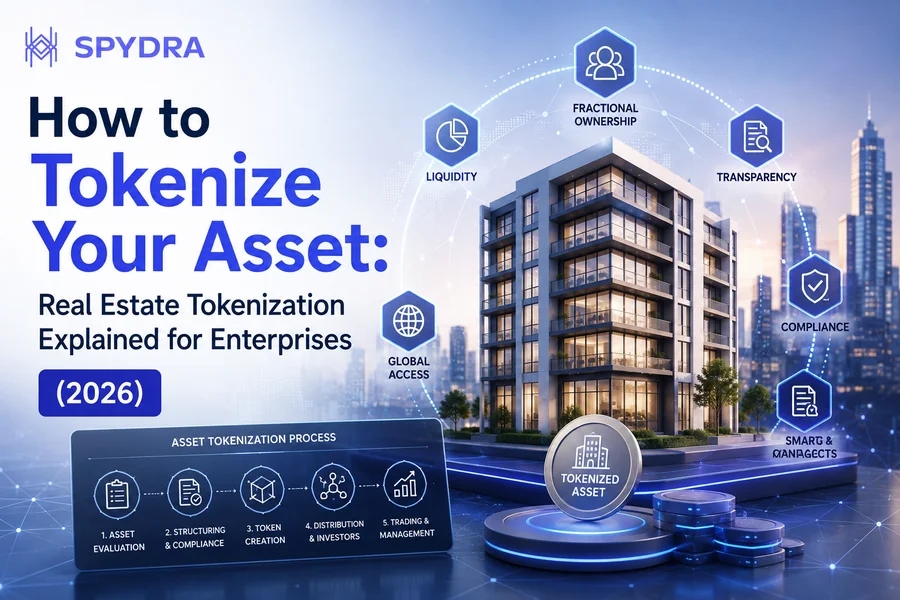
How to Tokenize Your Asset:Real Estate Tokenization Explained for Enterprises (2026)
Executive Summary
To tokenize your asset is to represent legal or economic rights over that asset as digital tokens on a blockchain, replacing paper title, spreadsheets, and manual reconciliation with a programmable, auditable ledger. Real estate tokenization is the application of this idea to property: a building, a land parcel, or a real estate fund is divided into digital tokens that each represent a fractional, verifiable claim on the underlying asset.
For enterprises, the appeal is structural rather than speculative. Traditional real estate is capital-intensive, slow to transact, and geographically restricted. Tokenization compresses settlement from weeks to near real time, lowers investment minimums so capital can be raised from a broader base, and embeds compliance directly into the transfer logic through smart contracts. Deloitte’s Center for Financial Services forecasts the tokenized real estate market will expand from an estimated $0.3 trillion in 2024 to approximately $4 trillion by 2035 — a 27% compound annual growth rate — as private funds, securitized debt, and land development assets move on-chain.
This guide walks enterprise decision-makers through what it actually means to tokenize an asset, how real estate tokenization works end to end, the benefits and risks involved, the regulatory landscape across major markets, and the infrastructure choices — including permissioned platforms such as Spydra, built on Hyperledger Fabric — that determine whether a tokenization program succeeds or stalls in pilot.
Key Statistics at a Glance
| Metric | Figure | Source |
| Tokenized real estate market, 2024 (est.) | ~$0.3 trillion | Deloitte Center for Financial Services |
| Tokenized real estate market, 2035 (forecast) | ~$4 trillion (27% CAGR) | Deloitte Insights, 2025 |
| Tokenized loans and securitizations by 2035 | ~$2.39 trillion | Deloitte Insights |
| Broader illiquid-asset tokenization opportunity by 2030 | ~$16 trillion | Boston Consulting Group / ADDX, 2022 |
| Tokenized financial assets by 2030, base case | ~$1.9–2 trillion (up to $4T bullish) | McKinsey & Company, 2024 |
| Total distributed on-chain RWA value, mid-2026 | ~$35 billion (ex-stablecoins) | RWA.xyz |
Note: forecasts vary by methodology and scope. BCG’s figure covers illiquid assets broadly, not real estate alone, while Deloitte’s and McKinsey’s estimates use narrower, asset-specific definitions. Treat any single number as directional, not a guarantee.
Introduction
Global real estate is one of the largest asset classes in the world, commonly estimated in the hundreds of trillions of dollars when land, residential, and commercial property are combined. Yet for an asset class of that size, the mechanics of buying, selling, and financing property have barely changed in decades. A commercial transaction can involve title searches, escrow accounts, multiple legal intermediaries, and settlement windows measured in weeks. Minimum investment sizes for institutional-grade assets — a logistics park, a Grade-A office tower, a hospitality portfolio — routinely run into the millions, locking out all but the largest investors.
This is the backdrop against which enterprises are now asking how to tokenize your asset and, more specifically, how real estate tokenization can be applied to their own portfolios. Blockchain-based tokenization does not change what a building is; it changes how ownership in that building is recorded, divided, transferred, and financed. Instead of a deed sitting in a filing cabinet and a capitalization table maintained in a spreadsheet, ownership becomes a set of digital tokens governed by smart contracts, verifiable on a shared ledger, and transferable to eligible investors without weeks of manual reconciliation.
For real estate developers, REIT managers, banks, asset managers, family offices, and government land authorities, this shift is no longer theoretical. Institutional players are running live tokenization pilots for commercial buildings, private real estate funds, and even government-linked infrastructure. The rest of this guide explains, step by step, what it takes to tokenize your asset and why real estate tokenization has become one of the fastest-growing use cases in enterprise blockchain.
What Does It Mean to Tokenize Your Asset?
To tokenize an asset means converting the ownership or economic rights of a physical or financial asset into blockchain-based digital tokens that can be securely issued, managed, transferred, and traded. Each token is a digital record of a claim — full ownership, fractional ownership, or a right to income — that is cryptographically verifiable and governed by rules encoded in a smart contract.
In practice, tokenizing an asset combines several building blocks that enterprises need to understand before starting a program:
- Digital ownership: a blockchain-based token acts as the authoritative record of who owns what share of the asset, replacing or supplementing paper title.
- Blockchain ledger: a shared, tamper-evident record that all authorized parties can verify, reducing disputes over ownership history.
- Smart contracts: self-executing code that enforces transfer restrictions, distributes income, and automates corporate actions without manual intervention.
- Fractional ownership: dividing a high-value asset into smaller, tradable units so more investors can participate at lower minimums.
- Token standards: technical specifications (fungible or non-fungible) that define how a token behaves, transfers, and integrates with wallets and exchanges.
- Asset-backed tokens: tokens whose value is tied to a real, off-chain asset, requiring legal structuring to make the link enforceable.
- Compliance controls: embedded KYC/AML checks, investor accreditation rules, and jurisdictional transfer restrictions enforced at the smart-contract level.
A Simple Tokenization Workflow
| Physical Asset
↓ Legal Structuring ↓ Property Valuation ↓ Digital Token Creation ↓ Smart Contract Deployment ↓ KYC / AML Verification ↓ Primary Offering ↓ Secondary Trading ↓ Income Distribution ↓ Asset Lifecycle Management |
| Key Takeaway: Tokenizing an asset is a legal and operational transformation as much as a technical one — the token is only as reliable as the legal structure, valuation process, and compliance controls behind it. |
What Is Real Estate Tokenization?
Real estate tokenization is the process of converting ownership or economic rights in a property — or a pool of properties — into blockchain-based digital tokens. Each token represents a verifiable, tradable claim on the underlying real estate, whether that is direct fractional ownership, a share in a special purpose vehicle (SPV) that holds the property, or a right to a stream of rental income.
Unlike a traditional Real Estate Investment Trust (REIT) unit, which is typically cleared through conventional securities infrastructure, a tokenized real estate instrument settles on a blockchain, which can shorten settlement cycles, extend accessibility to new categories of global investors, and enable programmable features such as automated rent distribution.
Real estate tokenization applies across a wide range of property types, each with different investor profiles and risk characteristics:
- Residential properties and multifamily housing portfolios
- Commercial office buildings and mixed-use developments
- Hotels and hospitality assets
- Industrial and logistics warehouses
- REITs and existing real estate fund structures
- Industrial parks and special economic zones
- Infrastructure assets with real-estate components, such as data centers and toll-linked developments
| Key Takeaway: Real estate tokenization is not limited to trophy commercial assets — it applies equally to residential portfolios, hospitality, industrial real estate, and existing REIT structures that want a digital-native distribution and settlement layer. |
Why the Traditional Real Estate Industry Needs Tokenization
Real estate has historically been one of the least liquid major asset classes. A handful of structural frictions explain why enterprises are turning to tokenization rather than incremental process fixes:
- Illiquidity: exiting a real estate position can take months, unlike listed securities that trade in seconds.
- High minimum investments: institutional-grade assets are typically only accessible to large investors or funds.
- Long settlement periods: transactions routinely involve weeks of legal, escrow, and title work.
- High transaction costs: brokers, lawyers, notaries, and registration fees add up across every deal.
- Multiple intermediaries: title companies, escrow agents, banks, and registrars all sit between buyer and seller.
- Paper-based ownership: reliance on physical deeds and manual registries increases fraud and dispute risk.
- Geographic restrictions: cross-border real estate investment is constrained by local banking rails and regulatory friction.
- Limited access to capital: developers and owners have fewer efficient ways to raise capital from a broad investor base.
Traditional Real Estate vs. Tokenized Real Estate
| Traditional Real Estate | Tokenized Real Estate |
| Paper ownership | Digital ownership |
| High investment threshold | Fractional ownership |
| Weeks/months settlement | Near real-time settlement |
| High legal costs | Automated processes |
| Local investors | Global participation |
| Limited liquidity | Secondary market trading |
| Manual compliance | Automated compliance |
| Key Takeaway: Tokenization does not eliminate the need for legal, valuation, and compliance work — it automates and digitizes the parts of the process that are currently manual, slow, and paper-based. |
Step-by-Step Process to Tokenize Your Asset
A disciplined, enterprise-grade approach to real estate tokenization generally follows these stages:
1. Asset selection: Identify the property or portfolio best suited to tokenization based on income profile, valuation clarity, and investor demand.
2. Due diligence: Verify title, liens, zoning, and financial history before any digital representation is created.
3. Legal structuring: Establish the legal wrapper — direct ownership, an SPV, or a fund — that gives the token an enforceable claim on the asset.
4. SPV creation (if applicable): Set up a special purpose vehicle to hold the property and issue tokens representing shares in the SPV.
5. Property valuation: Commission an independent valuation to anchor the token issuance price and ongoing net asset value.
6. Token economics: Define total token supply, minimum investment size, income rights, and any governance rights attached to tokens.
7. Smart contract deployment: Encode transfer restrictions, distribution logic, and compliance rules into the token’s smart contract.
8. KYC/AML integration: Connect identity verification and sanctions screening so only eligible investors can hold or trade tokens.
9. Investor onboarding: Enable qualified investors to complete subscription documents and wallet setup.
10. Token issuance: Mint and distribute tokens to verified investors during the primary offering.
11. Secondary trading: Enable eligible transfers on a compliant secondary market or exchange, where regulation permits.
12. Rental income distribution: Automate periodic income payouts to token holders via smart contract.
13. Governance: Manage voting rights or consent mechanisms for major decisions affecting the underlying asset.
14. Corporate actions: Handle refinancing, capital calls, or ownership restructuring through on-chain workflows.
15. Exit and redemption: Provide a defined path for investors to redeem or sell tokens at the end of the investment period.
| Key Takeaway: The sequence matters: legal structuring and due diligence must be locked down before a single token is minted. Skipping straight to smart contract deployment is the most common reason enterprise tokenization pilots stall. |
Benefits of Real Estate Tokenization
Increased Liquidity
Tokenized ownership can be transferred on a secondary market far faster than a conventional property sale, giving investors a realistic path to exit without waiting for a full building sale.
| Key Takeaway: Liquidity is improved relative to traditional real estate, not guaranteed — secondary market depth still depends on investor demand. |
Fractional Ownership
Dividing a property into smaller, tradable units lowers the minimum investment size, letting a broader range of investors participate in institutional-grade assets.
| Key Takeaway: Fractional ownership expands the investor base for assets that were previously accessible only to large capital allocators. |
Global Investor Access
Digital tokens can, subject to regulation, be offered to investors across borders without the banking friction of a traditional cross-border property purchase.
| Key Takeaway: Global access still requires jurisdiction-by-jurisdiction compliance — tokenization removes technical friction, not legal friction. |
Lower Transaction Costs
Automating parts of the transfer, compliance, and distribution process reduces reliance on intermediaries and the fees associated with each one.
| Key Takeaway: Cost savings come from automation of repetitive administrative work, not from bypassing legal or regulatory requirements. |
Faster Settlement
Smart contracts can settle eligible transfers in near real time once compliance checks clear, compared with the weeks typical of conventional closings.
| Key Takeaway: Settlement speed is a direct, measurable benefit and one of the clearest reasons institutions are piloting tokenization today. |
Enhanced Transparency
A shared ledger gives all authorized parties the same real-time view of ownership, transaction history, and distributions.
| Key Takeaway: Transparency benefits compliance teams and auditors as much as investors, by reducing reconciliation work. |
Immutable Ownership Records
Blockchain records are tamper-evident, reducing the risk of disputed or duplicated ownership claims that can arise with paper-based registries.
| Key Takeaway: Immutability protects record integrity but does not replace the underlying legal title — the two must be kept consistent. |
Smart Contract Automation
Recurring processes — income distribution, compliance checks, transfer restrictions — run automatically once encoded, cutting manual administrative overhead.
| Key Takeaway: Automation only reduces risk if the smart contract logic is audited and accurately reflects the legal agreement it represents. |
Improved Compliance
KYC/AML and investor accreditation rules can be enforced at the point of transfer, rather than checked retroactively.
| Key Takeaway: Embedding compliance in the token itself reduces the chance of an ineligible investor ending up on the cap table. |
Portfolio Diversification
Lower minimums make it easier for investors to spread capital across multiple properties, geographies, and asset types.
| Key Takeaway: Diversification benefits scale with the breadth of tokenized offerings available on a given platform. |
Better Capital Formation
Developers and owners can raise capital from a wider investor pool without the overhead of a full public offering.
| Key Takeaway: Capital formation improves most clearly for mid-market assets that are too small for traditional institutional syndication. |
24/7 Digital Asset Accessibility
Investors can view holdings, track distributions, and in permitted markets, trade tokens outside conventional market hours.
| Key Takeaway: Round-the-clock accessibility is an operational convenience — actual trading is still bound by applicable securities regulation. |
Global Market Trends in Real Estate Tokenization
Institutional adoption of real estate tokenization has moved from pilot projects to production-scale deployments over the past two years. Deloitte’s Center for Financial Services forecasts the tokenized real estate market will grow from an estimated $0.3 trillion in 2024 to approximately $4 trillion by 2035, a 27% compound annual growth rate, with tokenized loans and securitizations expected to account for roughly $2.39 trillion of that total. Deloitte frames this growth around three areas: private real estate funds moving on-chain, securitized loan ownership, and tokenization of under-construction or undeveloped land projects.
Estimates for the broader tokenization opportunity vary by scope and methodology. Boston Consulting Group, together with ADDX, estimated in 2022 that tokenization of illiquid assets generally — not real estate alone — could represent a $16 trillion opportunity by 2030. McKinsey & Company has published a more conservative base case, projecting tokenized financial assets (excluding cryptocurrencies and stablecoins) could reach roughly $1.9–2 trillion by 2030, rising to as much as $4 trillion in an optimistic scenario, with real estate identified as one of several asset classes in scope alongside bonds and equities. Enterprises should treat these figures as directional signals of institutional confidence rather than precise predictions, since forecasts from different firms use different definitions of what counts as “tokenized.”
On-chain data offers a more immediate read on momentum. According to RWA.xyz, total distributed value of tokenized real-world assets — across Treasuries, private credit, commodities, and real estate-linked products — climbed to roughly $35 billion by mid-2026, up from around $14 billion at the start of the year, reflecting rapid institutional entry into tokenized instruments generally, even as real estate-specific volumes remain a smaller share of that total than tokenized Treasuries and private credit.
Several trends are shaping how this growth is playing out on the ground:
- Institutional adoption: asset managers and banks are moving from proof-of-concept pilots to live, revenue-generating tokenization programs.
- Tokenized commercial real estate: office, industrial, and logistics assets are early candidates because of clearer income streams and valuation methodologies.
- Luxury property tokenization: high-value residential and hospitality assets are being fractionalized to reach a wider investor base.
- Infrastructure tokenization: data centers and other infrastructure with real-estate components are being explored as tokenizable asset classes.
- Cross-border investment: tokenization is being positioned as a way to widen the investor base for real estate in emerging and developed markets alike.
- Regulatory progress: several jurisdictions have introduced or clarified frameworks specifically addressing digital assets and tokenized securities, discussed in more detail below.
| Key Takeaway: Forecasts diverge widely by source and scope, but every major research firm — Deloitte, BCG, and McKinsey alike — agrees on the direction: tokenization of real estate and other illiquid assets is moving from experimentation to institutional infrastructure. |
Enterprise Use Cases
Real estate tokenization is being applied across a growing range of enterprise scenarios:
Commercial office buildings: Fractionalizing ownership of Grade-A office assets to attract a broader institutional and accredited investor base.
Apartment complexes: Tokenizing multifamily residential portfolios to raise capital while retaining professional management.
Hotels and hospitality: Structuring hospitality assets as income-generating tokens tied to occupancy and revenue performance.
Industrial parks: Enabling fractional participation in large industrial developments that were previously accessible only to institutional capital.
Logistics warehouses: Tokenizing warehouse and distribution assets to match rising demand from e-commerce-driven logistics growth.
Data centers: Applying tokenization to the real-estate component of data center developments as digital infrastructure investment grows.
Student housing: Fractionalizing purpose-built student accommodation to appeal to yield-focused retail and institutional investors.
Luxury villas: Offering fractional access to high-value residential and vacation properties that were previously single-owner assets.
REIT digitization: Giving existing REIT structures a blockchain-based issuance and settlement layer alongside traditional securities infrastructure.
Government land assets: Enabling public sector entities to digitize land records and explore tokenized financing for public infrastructure.
Infrastructure projects: Structuring long-duration infrastructure investments as tokenized instruments to attract patient, diversified capital.
| Key Takeaway: The common thread across enterprise use cases is not the property type but the capital problem being solved: reaching a wider investor base, unlocking liquidity, or replacing manual administration with automated infrastructure. |
Blockchain Technologies Behind Real Estate Tokenization
A functioning tokenization program depends on a stack of underlying technologies working together:
- Smart contracts: self-executing code that encodes ownership rules, transfer restrictions, and distribution logic.
- Distributed ledger technology: the shared, tamper-evident database that records every transaction and ownership change.
- Permissioned vs. public blockchain: permissioned networks such as Hyperledger Fabric restrict participation to verified entities, which suits regulated enterprise use cases, while public blockchains offer broader reach but less native control over who can transact.
- Token standards: technical formats that define how tokens are issued, transferred, and integrated with wallets and exchanges.
- Digital identity: verified, reusable identity credentials that streamline KYC checks across multiple offerings.
- Wallets: the interfaces investors use to hold, view, and transact tokenized assets.
- Oracle integration: services that bring off-chain data — such as valuations or rental income figures — onto the blockchain in a verifiable way.
- Multi-signature governance: requiring multiple authorized approvals for sensitive actions, reducing single-point-of-failure risk.
- API integrations: connections into enterprise systems such as ERP, CRM, and property management software so tokenized records stay in sync with operational data.
- Asset lifecycle management: tooling that tracks a tokenized asset from issuance through distributions, corporate actions, and eventual redemption.
| Permissioned vs. Public Blockchain — Why It Matters for Enterprises
Permissioned blockchains restrict network participation to vetted, known entities, which maps naturally onto regulated real estate transactions that already require KYC/AML and investor accreditation. Public blockchains offer wider potential distribution and liquidity but require additional compliance tooling to restrict transfers to eligible investors. Many enterprise tokenization programs use a permissioned core for issuance and compliance, with optional bridges to public networks for secondary liquidity where regulation allows. |
| Key Takeaway: Blockchain choice is a compliance and governance decision as much as a technical one — permissioned infrastructure tends to align more naturally with the regulatory obligations that come with real estate securities. |
Regulatory and Compliance Considerations
Real estate tokenization sits at the intersection of securities law, property law, and financial regulation. Enterprises need to address several compliance dimensions before launching a program:
- Securities regulations: in most jurisdictions, a tokenized real estate offering that promises returns is treated as a security and must comply with applicable securities laws.
- KYC and AML: identity verification and anti-money-laundering checks are required before investors can subscribe to or trade tokens.
- Investor accreditation: many jurisdictions restrict certain tokenized offerings to accredited or qualified investors.
- Tax implications: token issuance, transfers, and income distributions can trigger different tax treatment depending on jurisdiction and structure.
- Custody: enterprises must decide how private keys and digital assets are custodied, whether self-custodied, held by a regulated custodian, or managed through institutional-grade infrastructure.
- Data privacy: investor and property data captured during onboarding must comply with applicable data protection regulation.
- Cross-border compliance: offering tokens to investors in multiple jurisdictions means satisfying the securities and AML regimes of each one.
- Digital identity: verifiable digital identity frameworks are increasingly used to streamline compliant onboarding across jurisdictions.
Regional Regulatory Snapshot
- European Union: the Markets in Crypto-Assets (MiCA) regulation establishes a harmonized framework for crypto-asset issuance and service provision across EU member states, providing more legal clarity for tokenized offerings that fall within its scope.
- Singapore: the Monetary Authority of Singapore has taken an active regulatory sandbox approach, supporting tokenization pilots for funds and other financial instruments under existing securities frameworks.
- UAE: financial free zones such as ADGM and DIFC have introduced dedicated digital asset regulatory frameworks aimed at attracting tokenization activity.
- Hong Kong: regulators have supported tokenized bond issuances and published guidance for intermediaries dealing in tokenized securities.
- United States: tokenized real estate offerings are generally evaluated under existing securities law, with exemptions such as Regulation D, Regulation A+, or Regulation S commonly used depending on investor base.
- India: state and national initiatives are beginning to address blockchain-based asset and land record frameworks; Maharashtra’s DELTA Act is one example of a state-level initiative exploring blockchain-enabled governance frameworks relevant to digital asset infrastructure.
| Key Takeaway: Regulatory frameworks for tokenized real estate remain jurisdiction-specific and are evolving quickly — enterprises should treat legal counsel and local regulatory review as a prerequisite for every market they plan to offer tokens in, not a one-time exercise. |
Challenges of Real Estate Tokenization
Regulatory uncertainty. Rules differ by jurisdiction and continue to evolve. Mitigation: Work with legal counsel in each target market and favor platforms with built-in compliance controls that can adapt as rules change.
Secondary market liquidity. Liquidity is improved relative to traditional real estate but is not automatic — a token still needs willing buyers. Mitigation: Prioritize assets and jurisdictions where an active secondary market or licensed trading venue already exists.
Cybersecurity. Digital infrastructure introduces new attack surfaces around wallets, smart contracts, and custody systems. Mitigation: Use audited smart contracts, institutional-grade custody, and continuous security monitoring.
Custody. Safekeeping of private keys and digital assets requires new operational controls compared with traditional title custody. Mitigation: Adopt regulated custodians or multi-signature governance models for high-value holdings.
Smart contract risks. Bugs or design flaws in smart contract code can create financial or legal exposure. Mitigation: Commission independent smart contract audits before any mainnet deployment involving investor funds.
Oracle dependency. On-chain records are only as accurate as the off-chain data feeding them, such as valuations or income figures. Mitigation: Use reputable, verifiable oracle services and cross-check critical data points.
Property valuation. Real estate valuation remains partly subjective and infrequent compared with liquid securities. Mitigation: Commission independent, periodic valuations and disclose the methodology to investors.
Investor education. Many investors are unfamiliar with how tokenized ownership differs from direct or REIT-based ownership. Mitigation: Provide clear documentation explaining legal rights, risks, and how tokens map to underlying property rights.
Cross-chain interoperability. Tokens issued on one blockchain may not easily interact with assets or investors on another. Mitigation: Evaluate interoperability requirements early and choose infrastructure that supports the bridges you are likely to need.
| Key Takeaway: None of these challenges are unique to real estate tokenization — they mirror the same due-diligence, security, and disclosure practices that apply to any regulated financial product. What changes is that more of the control now lives in code, which raises the bar on audit rigor. |
How Spydra Helps Enterprises Tokenize Assets
Spydra is an enterprise-grade asset tokenization platform built on Hyperledger Fabric, designed for organizations that need to tokenize real estate and other real-world assets without building blockchain infrastructure from scratch. Rather than positioning tokenization as a purely public-blockchain, retail-crypto activity, Spydra’s permissioned architecture is built around the compliance, governance, and lifecycle management requirements that enterprise real estate tokenization programs actually need.
Spydra supports enterprise real estate tokenization programs across several dimensions:
- Tokenize real estate assets: convert ownership or income rights in a property into digital tokens backed by a defined legal structure.
- Manage asset lifecycles: track issuance, distributions, corporate actions, and redemption from a single platform.
- Deploy low-code tokenization workflows: configure token issuance and compliance rules without extensive custom blockchain development.
- Automate compliance: enforce KYC/AML checks and investor eligibility rules at the point of transfer, not after the fact.
- Support permissioned and public blockchains: structure tokenization on a permissioned core, with optional public-network bridges where appropriate.
- Integrate KYC/AML: connect identity verification providers directly into the onboarding and transfer workflow.
- Manage investor onboarding: handle subscription documentation, wallet provisioning, and eligibility verification.
- Automate distributions: schedule and execute rental income or other distributions directly to token holders.
- Enforce transfer restrictions: encode jurisdictional and accreditation-based restrictions directly into the token.
- Provide audit trails: maintain a complete, tamper-evident record of every transaction for regulators and auditors.
- Integrate APIs with enterprise systems: connect tokenization workflows with existing ERP, CRM, and property management software so records stay synchronized.
| Key Takeaway: The technology stack a platform uses matters less than whether it is built around the legal, compliance, and lifecycle realities of real estate — Spydra’s permissioned, Hyperledger Fabric-based architecture is designed with that enterprise reality as the starting point. |
The Future of Real Estate Tokenization
Several emerging trends are likely to shape the next phase of real estate tokenization as the technology and regulatory environment mature:
- AI-powered property management: combining tokenized ownership records with AI-driven valuation and portfolio monitoring.
- Tokenized mortgages: representing mortgage-backed obligations as digital tokens to streamline securitization and servicing.
- On-chain lending: using tokenized real estate as collateral for programmable, automated lending arrangements.
- CBDC settlement: central bank digital currencies could eventually enable native, regulated on-chain settlement for tokenized property transactions.
- DeFi integration: connecting tokenized real estate to decentralized finance protocols, subject to regulatory clarity.
- Digital identity: broader adoption of verifiable digital identity to streamline compliant investor onboarding across platforms.
- Cross-border marketplaces: dedicated venues for trading tokenized real estate across jurisdictions, within applicable regulatory limits.
- Programmable ownership: increasingly sophisticated smart contract logic governing income splits, governance rights, and exit conditions.
- Institutional adoption: continued entry of banks, asset managers, and sovereign-linked investors into tokenized real estate.
- Tokenized real estate funds: fund structures that are natively tokenized from inception, rather than retrofitted from traditional vehicles.
| Key Takeaway: The next phase of real estate tokenization will be defined less by blockchain novelty and more by how well platforms integrate compliance, identity, and traditional financial infrastructure — the enterprises that treat tokenization as infrastructure, not experimentation, will be best positioned. |
Frequently Asked Questions
What does it mean to tokenize your asset?
To tokenize your asset means converting the ownership or economic rights of that asset into blockchain-based digital tokens that can be securely issued, managed, transferred, and traded, typically governed by smart contracts and an underlying legal structure.
What is real estate tokenization?
Real estate tokenization is the process of converting ownership or income rights in a property into blockchain-based digital tokens, enabling fractional ownership, faster settlement, and broader investor access.
Is tokenized real estate legal?
Tokenized real estate is legal in most major jurisdictions when structured to comply with applicable securities, property, and anti-money-laundering laws. Legality depends on jurisdiction-specific structuring, not on the technology itself.
Which assets can be tokenized?
A wide range of assets can be tokenized, including real estate, bonds, private equity, commodities, intellectual property, and investment funds — any asset with a clearly defined ownership structure and valuation methodology.
Can residential property be tokenized?
Yes. Residential properties, including single-family homes and multifamily housing portfolios, can be tokenized, typically through a special purpose vehicle that holds the property and issues tokens representing fractional shares.
How do investors earn returns?
Investors in tokenized real estate typically earn returns through periodic income distributions, such as rental income, and potential appreciation in the token’s value if the underlying property increases in worth.
What are the risks?
Risks include regulatory uncertainty, limited secondary market liquidity, smart contract vulnerabilities, custody risk, and the same market and valuation risks that apply to traditional real estate investment.
How secure is blockchain property ownership?
Blockchain records are tamper-evident and cryptographically secured, which reduces the risk of disputed ownership records, but security also depends on smart contract audits, custody practices, and the legal structure linking the token to the property.
Which blockchain is best for real estate?
There is no single best blockchain for every case. Permissioned blockchains such as Hyperledger Fabric suit enterprises that need built-in access controls and regulatory alignment, while public blockchains can offer broader distribution where regulation allows.
Can enterprises tokenize commercial buildings?
Yes. Commercial office buildings, industrial parks, and logistics warehouses are among the most common enterprise tokenization use cases because of their clearer income streams and valuation methodologies.
What regulations apply?
Applicable regulations typically include securities law, KYC/AML requirements, investor accreditation rules, and local property law, and these vary significantly by jurisdiction — legal review is required for every market a tokenized offering targets.
How much does it cost to tokenize a property?
Costs vary based on legal structuring, valuation, smart contract development or platform licensing, and compliance integration; enterprise tokenization platforms generally reduce per-project cost compared with building custom blockchain infrastructure from scratch.
What is the difference between REITs and tokenized real estate?
REITs are traditional securities that pool investor capital into real estate, cleared through conventional financial market infrastructure, while tokenized real estate uses blockchain-based tokens for issuance, transfer, and settlement — some platforms are also exploring tokenized REIT structures that combine both.
How does fractional ownership work?
Fractional ownership divides a property’s total value into smaller, tradable tokens, so each investor holds a proportional digital claim on the underlying asset’s income and, where structured, its residual value.
How can businesses start tokenizing assets?
Businesses typically start by selecting a suitable asset, completing legal structuring and valuation, and partnering with an enterprise tokenization platform that provides compliance-ready smart contracts, KYC/AML integration, and lifecycle management tools.
Do tokenized real estate investors get legal ownership?
It depends on the structure. Some tokenization models grant direct fractional legal title, while others grant tokens representing shares in an SPV that holds legal title — the specific rights attached to a token should always be defined in the offering documents.
Can tokenized real estate be traded 24/7?
Tokens can technically be transferred at any time, but actual trading is still bound by the securities regulations and market infrastructure that govern the specific offering, so true 24/7 trading depends on where and how the token is listed.
Conclusion
Learning how to tokenize your asset is increasingly a strategic question for real estate developers, REIT managers, financial institutions, asset managers, and government organizations, not a purely technical one. Real estate tokenization gives enterprises a credible path to improve liquidity, lower transaction friction, attract global investors, and replace manual, paper-based administration with programmable, auditable infrastructure.
The opportunity is real, but so is the complexity: legal structuring, jurisdiction-specific compliance, valuation discipline, and security practices all need to be right before a single token is issued. Enterprises that treat tokenization as compliance-first infrastructure — rather than a speculative technology experiment — are the ones best positioned to capture the liquidity and capital-formation benefits that real estate tokenization promises.
Enterprise-grade platforms such as Spydra, built on permissioned infrastructure like Hyperledger Fabric, provide the compliance automation, lifecycle management, and system integrations needed to move a real estate tokenization program from pilot to production with the audit trail and investor protections that regulated markets require.
Appendix A: SEO Metadata
Meta Title: How to Tokenize Your Asset: Real Estate Tokenization Explained for Enterprises (2026)
URL Slug: /blog/how-to-tokenize-your-asset-real-estate-tokenization-enterprises
Primary Keywords: Tokenize Your Asset, Real Estate Tokenization
Secondary Keywords: Asset Tokenization, Asset Tokenization Platform, Tokenized Real Estate, Property Tokenization, Real Estate Asset Tokenization, Fractional Real Estate Ownership, Blockchain Real Estate, RWA Tokenization, Tokenized Property, Commercial Real Estate Tokenization, Residential Property Tokenization, Digital Real Estate Assets, Tokenized Real Estate Investment, Enterprise Tokenization Platform, Smart Contracts for Real Estate, Blockchain Property Investment
Suggested internal links: Asset Tokenization Platform (spydra.app), Real Estate Tokenization overview, Tokenized Funds, Tokenized Bonds, Hyperledger Fabric, Public Blockchain, Smart Contracts. Internal link slugs should be verified against the live Spydra sitemap before publishing, as proposed slugs may not match current live URLs.
Appendix B: Fact Verification Notes (Internal — Remove Before Publishing)
The following statistics were verified against named primary or reputable secondary sources at the time of drafting (August 2026). Confirm currency before publishing, as market forecasts in this space are revised frequently:
- Deloitte: tokenized real estate market ~$0.3T (2024) → ~$4T (2035), 27% CAGR; tokenized loans/securitizations ~$2.39T by 2035. Source: Deloitte Insights, “Tokenized real estate,” 2025 (deloitte.com).
- Boston Consulting Group / ADDX: $16 trillion illiquid-asset tokenization opportunity by 2030. This is a broad illiquid-asset figure, not real-estate specific — do not present as a real estate-only forecast. Source: BCG/ADDX report, 2022.
- McKinsey & Company: tokenized financial assets ~$1.9–2T base case by 2030, up to $4T bullish scenario, covering bonds, equities, and real estate. Source: McKinsey, “From ripples to waves,” 2024.
- RWA.xyz: total distributed on-chain RWA value ~$35B as of mid-2026, up from ~$14B at start of 2026 (figures fluctuate daily; re-verify at time of publishing).
- ✅ = confirmed against named source above. ⚠️ Any statistic not listed here should be treated as illustrative/industry-general framing rather than a cited figure, and removed or sourced before publishing.
Appendix C: JSON-LD Structured Data
Article Schema
| {
“@context”: “https://schema.org”, “@type”: “Article”, “headline”: “How to Tokenize Your Asset: Real Estate Tokenization Explained for Enterprises (2026)”, “description”: “A guide to how enterprises tokenize real estate assets, covering the process, benefits, risks, regulation, and 2026 market data.”, “author”: { “@type”: “Person”, “name”: “Manish Tewari”, “jobTitle”: “Blockchain Entrepreneur & Web3 Strategist” }, “publisher”: { “@type”: “Organization”, “name”: “Spydra”, “url”: “https://www.spydra.app” }, “datePublished”: “2026-08-06”, “dateModified”: “2026-08-06”, “mainEntityOfPage”: { “@type”: “WebPage”, “@id”: “https://www.spydra.app/blog/how-to-tokenize-your-asset-real-estate-tokenization-enterprises” } } |
FAQPage Schema (first 10 FAQs shown; extend with remaining items before publishing)
| {
“@context”: “https://schema.org”, “@type”: “FAQPage”, “mainEntity”: [ { “@type”: “Question”, “name”: “What does it mean to tokenize your asset?”, “acceptedAnswer”: { “@type”: “Answer”, “text”: “To tokenize your asset means converting the ownership or economic rights of that asset into blockchain-based digital tokens that can be securely issued, managed, transferred, and traded, typically governed by smart contracts and an underlying legal structure.” } }, { “@type”: “Question”, “name”: “What is real estate tokenization?”, “acceptedAnswer”: { “@type”: “Answer”, “text”: “Real estate tokenization is the process of converting ownership or income rights in a property into blockchain-based digital tokens, enabling fractional ownership, faster settlement, and broader investor access.” } }, { “@type”: “Question”, “name”: “Is tokenized real estate legal?”, “acceptedAnswer”: { “@type”: “Answer”, “text”: “Tokenized real estate is legal in most major jurisdictions when structured to comply with applicable securities, property, and anti-money-laundering laws. Legality depends on jurisdiction-specific structuring, not on the technology itself.” } }, { “@type”: “Question”, “name”: “Which assets can be tokenized?”, “acceptedAnswer”: { “@type”: “Answer”, “text”: “A wide range of assets can be tokenized, including real estate, bonds, private equity, commodities, intellectual property, and investment funds — any asset with a clearly defined ownership structure and valuation methodology.” } }, { “@type”: “Question”, “name”: “Can residential property be tokenized?”, “acceptedAnswer”: { “@type”: “Answer”, “text”: “Yes. Residential properties, including single-family homes and multifamily housing portfolios, can be tokenized, typically through a special purpose vehicle that holds the property and issues tokens representing fractional shares.” } }, { “@type”: “Question”, “name”: “How do investors earn returns?”, “acceptedAnswer”: { “@type”: “Answer”, “text”: “Investors in tokenized real estate typically earn returns through periodic income distributions, such as rental income, and potential appreciation in the token’s value if the underlying property increases in worth.” } }, { “@type”: “Question”, “name”: “What are the risks?”, “acceptedAnswer”: { “@type”: “Answer”, “text”: “Risks include regulatory uncertainty, limited secondary market liquidity, smart contract vulnerabilities, custody risk, and the same market and valuation risks that apply to traditional real estate investment.” } }, { “@type”: “Question”, “name”: “How secure is blockchain property ownership?”, “acceptedAnswer”: { “@type”: “Answer”, “text”: “Blockchain records are tamper-evident and cryptographically secured, which reduces the risk of disputed ownership records, but security also depends on smart contract audits, custody practices, and the legal structure linking the token to the property.” } }, { “@type”: “Question”, “name”: “Which blockchain is best for real estate?”, “acceptedAnswer”: { “@type”: “Answer”, “text”: “There is no single best blockchain for every case. Permissioned blockchains such as Hyperledger Fabric suit enterprises that need built-in access controls and regulatory alignment, while public blockchains can offer broader distribution where regulation allows.” } }, { “@type”: “Question”, “name”: “Can enterprises tokenize commercial buildings?”, “acceptedAnswer”: { “@type”: “Answer”, “text”: “Yes. Commercial office buildings, industrial parks, and logistics warehouses are among the most common enterprise tokenization use cases because of their clearer income streams and valuation methodologies.” } } ] } |
BreadcrumbList Schema
| {
“@context”: “https://schema.org”, “@type”: “BreadcrumbList”, “itemListElement”: [ { “@type”: “ListItem”, “position”: 1, “name”: “Home”, “item”: “https://www.spydra.app/” }, { “@type”: “ListItem”, “position”: 2, “name”: “Blog”, “item”: “https://www.spydra.app/blog” }, { “@type”: “ListItem”, “position”: 3, “name”: “How to Tokenize Your Asset: Real Estate Tokenization Explained for Enterprises (2026)”, “item”: “https://www.spydra.app/blog/how-to-tokenize-your-asset-real-estate-tokenization-enterprises” } ] } |


