
Introduction
In biotechnology and medical device development, the journey from a breakthrough concept to a functional prototype is often bottlenecked by a slow, costly, and opaque manufacturing process. Engineers designing intricate microfluidic chips or custom surgical instrument components frequently face weeks of waiting for quotes and production slots from traditional machine shops. Each minor design iteration triggers another cycle of lengthy communication and delay, severely slowing down R&D velocity and time-to-market.
The root cause lies in the linear, non-digital nature of traditional manufacturing supply chains. Each step — from submitting drawings and awaiting manual quotes to clarifying manufacturability and arranging logistics — relies on human interaction, introducing information lags and error risks. This model is fundamentally incompatible with the need for rapid prototyping, small-batch, and high-complexity development in biotech. This article reveals how online CNC milling services create a complete “digital thread,” restructuring the prototyping workflow. By enabling instant, automated Design for Manufacturability (DFM) analysis, real-time quoting, and digital order tracking, they eliminate up to 80% of non-value-added time, a transformation aligned with the digital integration values highlighted in smart manufacturing frameworks. To master this accelerated innovation capability, one must first understand the bottlenecks of traditional methods and then explore how online CNC milling solves them through digitization, automation, and specialization.
Why Do Traditional Prototyping Methods Fail to Meet the Pace of Biotech Innovation?
Traditional prototyping creates significant drag on biotech innovation due to three core bottlenecks. First, communication and quote delays inherent in email and phone-based processes can stretch the quoting cycle from days to weeks. Second, delayed manufacturability feedback means design flaws are often only discovered after parts are machined or during assembly, leading to costly rework and further delays. Finally, poor economics for low-volume production make traditional shops disinterested in small orders or lead to prohibitively high costs. Together, these factors extend prototype iteration cycles far beyond what fast-paced R&D can tolerate, stifling the rapid prototyping cycle essential for innovation.
1. The High Cost of Linear Communication and Manual Quoting
The traditional process for custom CNC milling services is inherently sequential. An engineer submits a design and then waits for a human project manager to review it, often requiring multiple clarification emails back and forth. This manual intervention introduces significant latency. For a complex microfluidic part, simply obtaining a final quote and scheduled start date can consume over a week. In a field where experiments are scheduled tightly, this delay directly translates to missed milestones and postponed research, creating a critical gap between digital design and physical verification.
2. The Iteration Trap: Late-Stage Design for Manufacturability (DFM) Discovery
Without immediate, automated analysis, manufacturability issues remain hidden. A design with overly thin walls or an internal corner that’s impossible to machine with a standard tool may proceed to production. The result is a prototype that fails to function, arrives with compromised features, or requires expensive, time-consuming secondary operations. This late-stage DFM discovery forces engineers into a reactive mode, fixing manufacturing problems instead of iterating on scientific function. Each unexpected iteration resets the clock on the lengthy communication and production queue, derailing development schedules.
3. The Economic Disincentive for Low-Volume, High-Complexity Work
Traditional machine shops are optimized for long production runs. Setting up for a one-off prototype or a batch of ten parts involves nearly the same programming and fixture setup time as for a thousand parts, but the cost must be absorbed by the tiny batch. This makes low-volume CNC milling economically challenging through traditional channels, often leading to high per-part costs or outright rejection of projects. For biotech startups and research labs, this creates a formidable barrier to physically testing and validating their innovative designs.
How Does the “Digital Thread” in Online CNC Milling Eliminate 80% of Pre-Production Delays?
Online CNC milling services collapse the traditional timeline by implementing a seamless, automated digital thread. This integrated workflow connects design to delivery through software, removing manual gates and delays. The process begins with instant, automated DFM and quoting, continues through a transparent digital workflow, and is supported by an integrated knowledge base of specialized machining parameters. This system is the engine behind achieving complex parts rapid machining.
1. Instant Automated DFM and Quote Generation
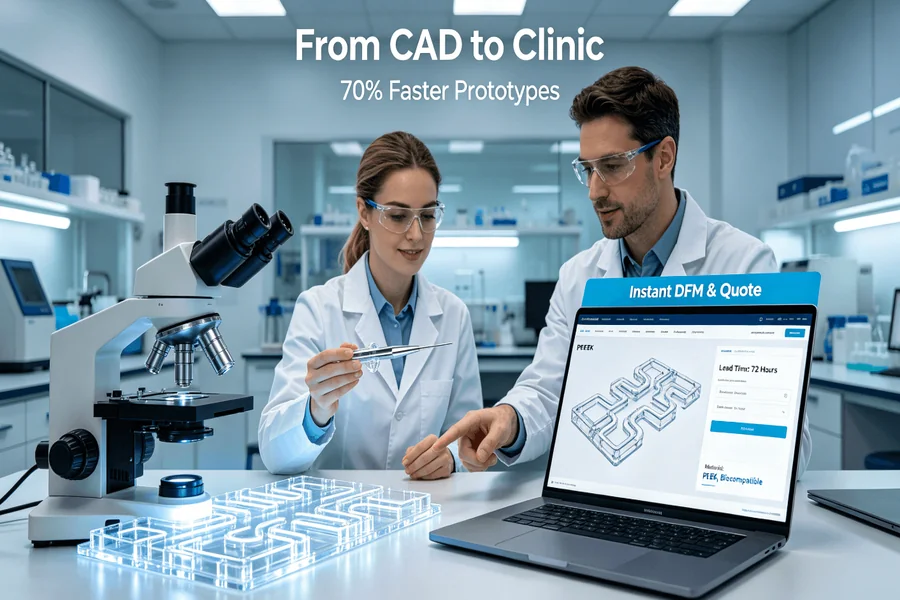
The core of the digital thread is the automated quoting engine. Engineers upload a 3D model (e.g., STEP, SLDPRT) and instantly receive an online CNC milling quote. More importantly, the system performs an immediate DFM analysis, flagging potential issues like tool accessibility, recommended wall thickness, and optimal feature sizing. This proactive feedback happens in minutes, not days, allowing for design optimization before any metal is cut. It transforms quote generation from a negotiation into an immediate engineering collaboration, providing clarity on cost and feasibility at the earliest possible stage.
2. A Fully Transparent and Integrated Digital Workflow
Upon order confirmation, the project enters a fully transparent digital pipeline. From job scheduling and machine assignment to real-time production status and final inspection reports, every step is trackable online. This end-to-end visibility eliminates the “black box” of traditional manufacturing and the need for status-update emails. The digital thread ensures that all specifications, revisions, and quality documents are centralized and accessible, reducing miscommunication errors and providing a clear audit trail — a critical advantage for regulated industries beginning their industrial automation journey.
3. Embedded Expertise for Specialized Materials and Geometries
Advanced online platforms embed deep machining expertise into their systems. For biotech applications, this includes optimized process parameters for biocompatible materials like PEEK, medical-grade stainless steels (316L), titanium alloys (Ti-6Al-4V), and even optically clear plastics for microfluidics. This built-in knowledge base lowers the technical barrier for engineers, who may not be machining experts, ensuring that their designs for sensitive materials are executed with proven strategies that maintain material integrity and achieve required surface finishes.
Case Study: From CAD to Functional Prototype in 72 Hours – A Microfluidic Device Example.
Consider the development of a protein crystallization research chip. The device features 100-micron wide channels requiring a mirror-like surface finish to prevent protein adhesion and enable clear imaging. Using a traditional shop, the first iteration took three weeks. By switching to a specialized online CNC milling service, the team uploaded their design on Monday morning. Automated DFM feedback suggested slight draft angles for deeper channels, and a quote was generated by afternoon. Machining of the aluminum master tool commenced Tuesday. The parts, with a Ra 0.4 µm surface finish, were shipped Wednesday and arrived Thursday for immediate hydrophilic coating and Friday experimental testing. This 72-hour turnaround enabled a week of rapid design-test-learn cycles that was previously impossible, perfectly illustrating the power of prototype CNC milling to accelerate biotech innovation.
Beyond Speed: What Are the 3 Critical Quality Advantages for Precision Biotech Components?
While speed is transformative, the quality imperative in biotech is non-negotiable. Online CNC milling delivers deeper quality advantages by systemizing precision, reducing error sources, and ensuring traceability. These benefits stem from automated pre-production checks, deep material-specific process knowledge, and the inherent consistency of digital workflows, all essential for precision CNC milling of life-critical components.
- Proactive Error Reduction Through Automated Design Analysis: The instant DFM analysis acts as a proactive quality gate. By automatically checking for manufacturability constraints — such as unrealistic aspect ratios, difficult-to-reach features, or insufficient tolerances for the selected material — the system prevents flawed designs from ever reaching the machine. This pre-production validation significantly reduces the risk of receiving non-conforming parts, saving not just time but also the budget and morale consumed by failed prototypes. It elevates the first article success rate dramatically.
- Process Expertise Encoded for Critical Materials: Producing a functional prototype isn’t just about shape; it’s about preserving material properties. A microfluidic chip machined from COP requires vastly different tooling, speeds, and cooling than a titanium bone plate. Reputable online services have codified this expertise. Their machining parameters for medical-grade PEEK, for instance, are optimized to prevent heat-induced stress cracking and delamination, which is crucial for maintaining the biocompatibility and mechanical integrity of the final part. This specialized knowledge is applied consistently, batch after batch.
- Built-in Consistency and Digital Traceability: The digital thread ensures that the approved design file and its associated machining instructions are the single source of truth. This eliminates version confusion and manual programming errors. Furthermore, every production step can be logged, and first-article inspection reports — often including CMM data — are generated digitally. This provides full digital traceability from material lot to finished part, creating an essential documentation foundation for later stages of regulatory submission and quality auditing, turning prototyping into a quality-assured process.
Is Low-Volume Production (1-100 Pieces) Economically Viable with Online CNC Milling? A Cost-Breakdown Analysis
For biotech, the path from prototype to pilot run or small-scale clinical trial often requires 1-100 parts. Traditional methods make this economically challenging, but online CNC milling reshapes the cost equation. By aggregating demand from multiple clients and optimizing machine utilization, these services make low-volume CNC milling highly viable. The total cost of ownership (TCO) becomes favorable when considering the elimination of tooling investment, reduced scrap from DFM optimization, and the value of accelerated time-to-market.
1. Eliminating the High Fixed Costs of Traditional Small Batches
The primary economic advantage is the elimination of NRE (Non-Recurring Engineering) costs and the amortization of setup time. A traditional shop charges a high premium for a small batch to cover dedicated machine time and programmer hours. An online CNC milling manufacturer, however, uses intelligent scheduling to nest multiple small jobs from different customers on a single machine setup with similar material, dramatically distributing fixed costs. This model transforms the economics, making a batch of 50 specialized parts as cost-effective per unit as a much larger run in a traditional model.
2. The Cost Composition: Transparency and Optimization
An online quote provides a transparent breakdown: material cost, machine time, and any required post-processing (like anodizing or passivation). This transparency allows for informed trade-offs. For example, switching from 7075 to 6061 aluminum alloy for CNC milling might reduce cost with minimal performance impact for a fixture. Furthermore, the upfront DFM suggestions can lead to design modifications that reduce machining time and material waste, lowering the final price before the order is even placed. The cost is contained and predictable.
3. The Strategic Value of On-Demand Production
Beyond direct cost, the on-demand model provides strategic financial benefits. It converts a large, upfront capital outlay (for a production mold or a large minimum order) into a flexible, variable operating expense. Companies can order exactly what they need, when they need it — for functional testing, pilot builds, or early clinical supplies — without tying up capital in inventory or committing to a final design prematurely. This financial agility is invaluable for cash-sensitive startups and research departments.
How to Select a Partner That Guarantees Both Agility and Compliance in Regulated Industries?
Choosing a manufacturing partner for biotech components requires balancing the need for speed with the imperative of quality and compliance. The selection criteria must extend beyond just price and lead time. Engineers must evaluate a potential partner’s foundational systems for quality management, material control, and documentation to ensure they can be both an agile prototyping resource and a compliant manufacturing partner. This due diligence is key to leveraging precision engineering for advanced production.
1. Verifying Quality Management and Regulatory Alignment
The first checkpoint is the quality management system. A partner should, at minimum, be ISO 9001 certified, demonstrating a commitment to documented processes and continuous improvement. For components touching clinical applications, a framework aligned with ISO 13485 (for medical devices) is a significant advantage. This certification signifies that the manufacturer has established processes for design control, risk management, and traceability — systems that ensure consistent quality and form the backbone of any future regulatory submission, even for early-stage prototypes.
2. Ensuring Material Integrity and Specialized Processing
For biocompatible parts, the material certificate is as important as the part itself. A qualified partner must provide full traceability, offering mill test reports (MTRs) or certificates of conformity for raw materials like implant-grade titanium or USP Class VI plastics. Furthermore, inquire about their specific experience and protocols for machining these materials. Do they have dedicated tooling and parameters for PEEK to prevent degradation? What is their process for ensuring the cleanliness of parts destined for sterile environments? This material and process expertise is non-negotiable.
3. Assessing Documentation and Communication Protocols
Agility cannot come at the expense of documentation. A reliable partner should automatically provide detailed documentation, including a First Article Inspection Report (FAIR) with dimensional results, material certifications, and a process traveler. Their digital platform should offer clear, real-time communication and secure data transfer. Selecting the right partner means securing a custom CNC milling manufacturer capable of simultaneously meeting the demands for rapid iteration and rigorous quality standards, thereby mitigating risks within the production process.
Conclusion
In biotechnology, where speed and precision are paramount, the pace of prototype development directly determines the success of innovation. Online CNC milling services, with their digital core, automated workflows, and embedded engineering intelligence, have emerged as a critical enabler. They transform prototype lead times from weeks to days while simultaneously enhancing quality through proactive DFM and specialized process knowledge. For engineers translating groundbreaking ideas into testable, verifiable physical entities, these services are no longer just a convenience but a strategic necessity, compressing development cycles and enabling a faster journey from concept to clinic.
FAQs
Q: What file format and tolerance information should I provide for a medical device prototype quote?
A: For the most accurate Online CNC Milling Quote, provide a 3D CAD file in STEP or Parasolid format with a PDF drawing. The drawing must specify critical dimensions, tolerances (e.g., ±0.025 mm), geometric tolerances, and surface finish (e.g., Ra 0.8 µm). For biocompatibility, state the exact material grade. This detail allows the CNC milling manufacturer to assess manufacturability and provide a precise cost and timeline.
Q: Can you machine transparent materials like PMMA or COP for microfluidic devices?
A: Yes, precision CNC milling excels with clear plastics like PMMA and COP/COC. Achieving clarity requires sharp, diamond-coated tools, optimized feed/speed rates, and proper cooling to prevent stress whitening. Post-processing like flame or vapor polishing enhances optical clarity. Partner with a supplier experienced in these sensitive materials for best results.
Q: What is the typical lead time for a complex, multi-material prototype batch?
A: For complex parts rapid machining with 2-3 materials (e.g., aluminum, PEEK, stainless steel), lead time for 5-10 pieces is typically 3-7 business days post-design approval. This includes programming, setup, machining, and basic inspection. Deep cavities, tight tolerances (<0.05mm), or required certifications can extend this. A proficient prototype CNC Milling service provides a clear timeline during quoting.
Q: How do you ensure part cleanliness for components used in sterile or cleanroom environments?
A: A rigorous cleaning protocol is essential. This involves ultrasonic cleaning in specialized solutions to remove oils and particulates, rinsing with deionized water, and drying in a controlled, particle-free environment. Parts are then bagged in cleanroom-compatible packaging. Always specify the required cleanliness level (e.g., ISO Class 5) when requesting a quote so the manufacturer can plan accordingly.
Q: What are the main advantages of 5-axis CNC milling over 3-axis for complex biotech parts?
A: 5-axis CNC milling is indispensable for parts with undercuts, complex 3D contours, or multi-sided features. It allows the tool to approach from any angle in a single setup, eliminating re-fixturing. This results in higher accuracy (no cumulative repositioning errors), superior surface finish on complex geometries, and the ability to machine deeper, intricate features inaccessible to 3-axis machines, making it ideal for custom surgical tools or implant prototypes.
Author Bio
The author is an expert specializing in precision manufacturing and rapid prototyping, dedicated to assisting biotechnology and medical device teams in transforming innovative concepts into tangible, physical products. The author’s team at LS Manufacturing provides end-to-end manufacturing solutions to innovators worldwide, with services ranging from single-piece prototyping to medium-batch production. Contact them today to accelerate your next major breakthrough: upload 3D models of your complex parts to receive a complimentary Design for Manufacturability (DFM) analysis — meeting the highest standards of the biotech industry — along with an instant quote.