
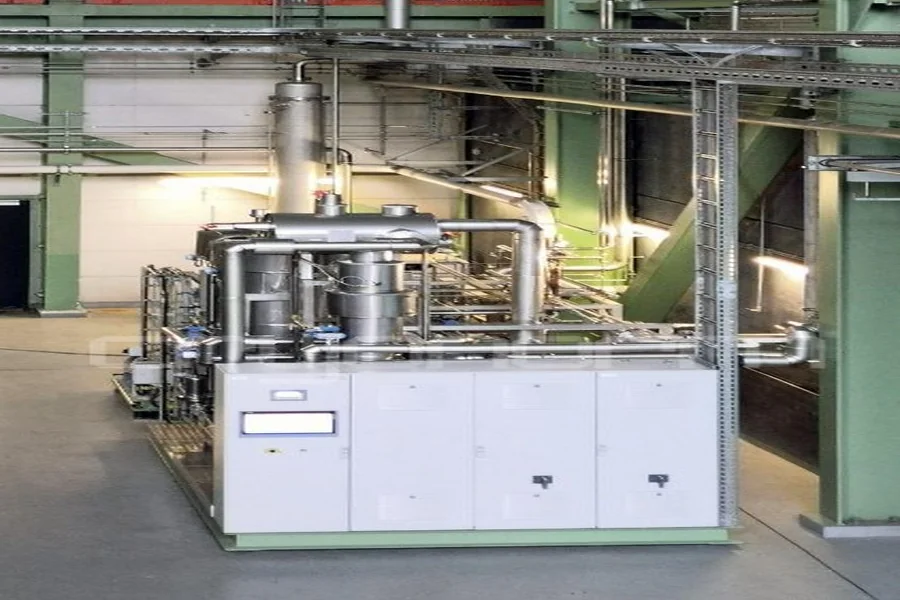
The global industry faces an urgent challenge to drastically reduce greenhouse gas emissions. One of the most effective methods for addressing CO2 emissions is capturing and reusing carbon dioxide from industrial waste streams and biogas plants. CO2 liquefaction plays a crucial role in the efficient processing, transportation, and storage of gaseous carbon dioxide. By liquefying the gas under controlled pressure and temperature, its volume is reduced by a factor of as much as six hundred, yielding logistical and economic benefits. However, liquefying carbon dioxide does require advanced thermodynamic systems and precise separation techniques. Modern CO2 liquefaction facilities are therefore increasingly being built as modular skids that can be installed directly at the gas source location. This eliminates the need to transport large volumes of gaseous product via pipelines over long distances. Liquefied CO2 can then be easily loaded into insulated tank trucks or ships for delivery to a wide range of end users.
How does the CO2 liquefaction process work?
The process of converting a gaseous stream into a liquid end product involves several consecutive steps. During the first phase of CO2 liquefaction, the incoming gas stream must be thoroughly purified. This is because biogenic sources, such as anaerobic digestion plants, contain traces of hydrocarbons, sulfur compounds, and other contaminants. Activated carbon filters remove these impurities from the gas, after which multi-stage oil-free compressors bring the gas to the desired process pressure to prevent subsequent condensation of contaminants.
After the compression phase, moisture is removed from the compressed gas using molecular sieve dryers. This is an essential step in CO2 liquefaction, as residual water molecules can freeze at cryogenic temperatures and cause pipes or heat exchangers to clog. Once the gas is completely dry, it is directed to a cryogenic cooling unit. Here, the carbon dioxide condenses into a liquid, while non-condensable gases such as nitrogen and oxygen remain in gaseous form.
In the final stage of the separation process, the non-condensable gases are vented or processed, after which the pure liquid product is transferred to cryogenic storage tanks. Reliable CO2 liquefaction systems must provide continuous pressure and temperature monitoring to ensure that the liquid remains stable and does not evaporate prematurely. This results in a high-quality end product that meets the strictest purity requirements for industrial and food applications.
The key steps in CO2 liquefaction
The process flow of advanced, on-site liquefaction units can be summarized in a clear sequence of six phases:
- Impurity Removal: Removal of trace substances and contaminants using advanced activated carbon filters.
- Gas Compression: Increasing the process pressure using high-efficiency oil-free compressors.
- Drying Process: Moisture removal using an automatic molecular sieve dryer to prevent ice formation.
- Cryogenic condensation: Cooling the gas stream, causing the carbon dioxide to condense into a liquid.
- Gas extraction: Separation of non-condensable components, such as nitrogen, from the liquid mixture.
- Refrigerated storage: Transfer of the purified product to insulated cryogenic storage tanks.
Scalability and industrial applications
An important consideration when selecting a system is the difference between modular and centralized systems. Small-scale, modular units for CO2 liquefaction offer enormous advantages for bioenergy companies and waste processors that capture biogenic gas. By installing the system on-site, transportation costs for gaseous carbon dioxide are eliminated. Furthermore, modular skids can be easily expanded as a site’s production capacity grows.
Liquid carbon dioxide is finding its way into a wide range of sectors. In the food and beverage industry, the pure liquid gas is used for carbonated beverages and as an environmentally friendly refrigerant to extend the shelf life of food products. In addition, greenhouse growers use captured CO2 to increase crop growth and productivity in greenhouses. Advanced CO2 liquefaction technology enables these market sectors to replace fossil-based carbon dioxide with a circular alternative.
In addition to its use in horticulture and the food industry, liquid CO2 is indispensable in large-scale Carbon Capture and Storage (CCS) projects. By capturing the gas at industrial sites and converting it through CO2 liquefaction, it can be safely transported to depleted offshore gas fields for permanent storage. This directly contributes to reducing the carbon footprint of heavy industries and helps make climate goals achievable.
Future prospects for liquefaction technology
The demand for sustainably produced liquid CO2 will only increase in the coming years. Rising prices for emission allowances and stricter environmental requirements are making the implementation of an in-house CO2 liquefaction unit commercially and operationally attractive for many companies. The combination of energy-efficient heat exchangers, automated control systems, and a compact footprint ensures that industrial players can effectively convert their emissions into valuable raw materials.