
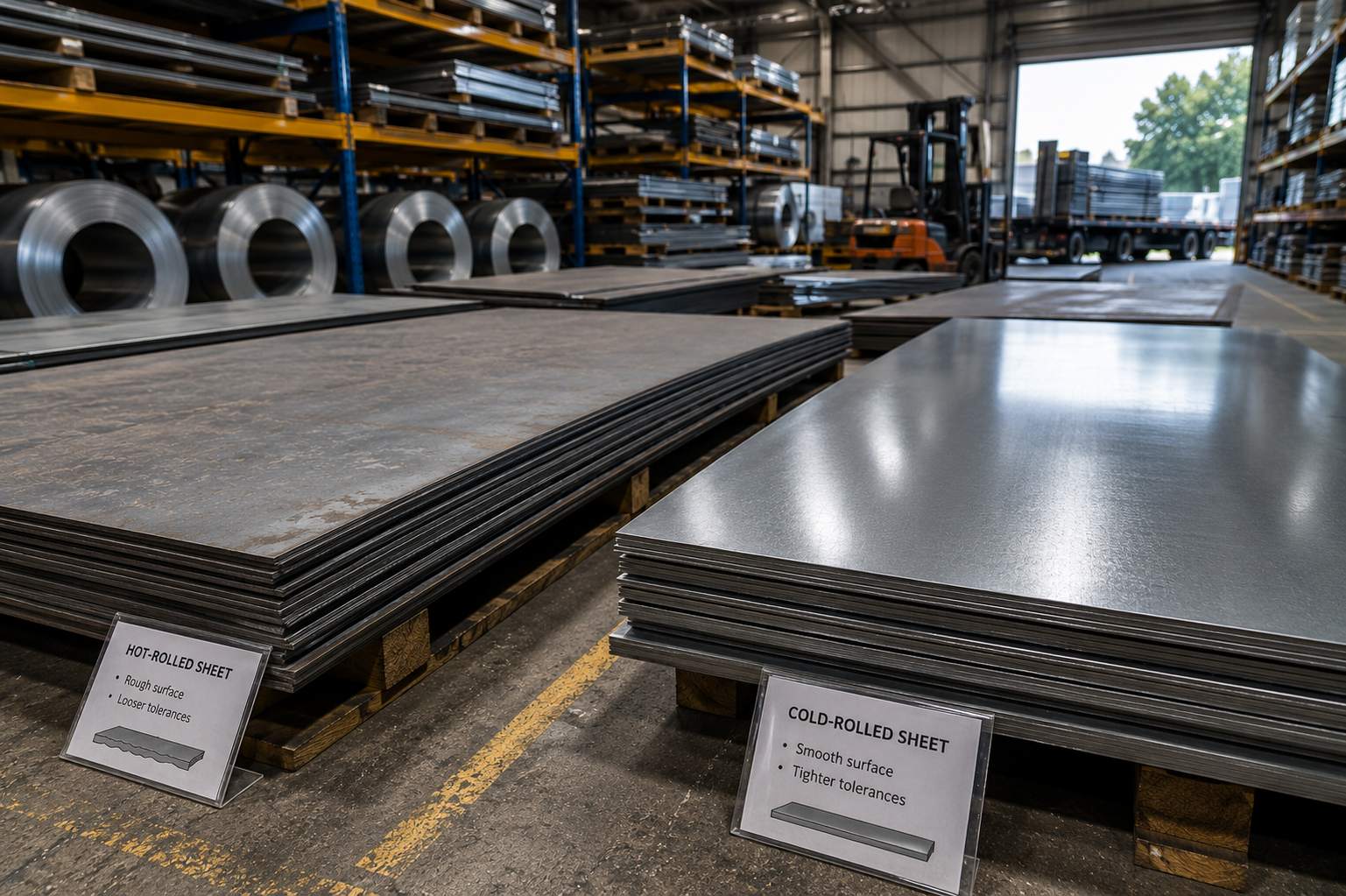
Two steel sheets can share identical dimensions on a spec sheet and still carry noticeably different prices. That is not a pricing error. Buyers run into this comparison constantly, and the invoice reflects the rolling process and the alloy just as much as it reflects the raw metal. Delivery timing adds its own line to the cost.
What separates hot-rolled from cold-rolled
Hot-rolled sheets take shape at temperatures above 1000°C, while the steel is still soft enough to work without cracking. The result is a rougher surface and looser dimensional tolerances than cold-rolled material, which goes through a second pass at room temperature after the hot-rolling stage.
Cold-rolling adds strength through work-hardening and leaves a smoother, tighter-toleranced sheet. That extra pass through the mill is the reason cold-rolled steel typically costs more per kilo. Hot-rolled is not automatically the cheaper choice in practice. A project that actually needs cold-rolled precision but gets fitted with hot-rolled material instead pays twice, once for the material and once for the rework. That calculation is worth making before placing an order, and it is exactly what a supplier’s Hot rolled sheets page from Tibnor is meant to help a buyer confirm.
Why identical dimensions carry different prices
Alloy content moves the price faster than thickness does. A standard structural sheet and a low-alloy sheet with added chromium or molybdenum can carry identical measurements and still differ significantly in cost per ton, since the added elements change how the steel resists corrosion and wear. Surface treatment stacks another cost on top because pickled and oiled sheets run through one processing line, galvanized or primed finishes through another, and none of that shows up when two sheets are compared by dimensions alone.
A case from the wholesale side makes this concrete: two 3mm sheets, identical in length and width, one in standard S235 structural steel, the other in a higher alloy grade with a pickled finish. The price gap between them can run well above what the thickness alone would suggest, purely because of composition and surface work. The gap is real. Anyone comparing steel by spec sheet alone will miss it every time.
How volume and delivery timing affect price
Material isn’t the whole price. Volume and urgency move the invoice just as much, and it is the part most buyers overlook.
A sheet pulled from standing stock in a common dimension is priced differently than the same dimension cut to a custom order under a rush deadline. Warehousing and cutting-line scheduling both factor into that second price. Steel and rebar are governed by separate standards, and the way these metals get classified is part of why a custom cut needs its own quote rather than a price pulled straight off a list.
In practice, a distributor such as Tibnor keeps high-volume standard dimensions in stock, which spares every customer from paying a rush premium on common sizes. Special orders outside that stocked range carry the lead-time premium instead. One detail few buyers ask about: a sheet cut partway through a coil sometimes carries a slightly different mill certificate than one cut at the coil’s start. That distinction matters for structural sign-off, though it never shows up on the price list.
Picking the right sheet for the job
Start with the load the sheet will carry, not the price per kilo. Structural framing and brackets, along with general fabrication work, rarely need cold-rolled tolerances, so hot-rolled steel handles the job at a lower cost.
Reach for cold-rolled when the part needs tight dimensional accuracy or a smooth surface that will take fine bends without cracking. Match the alloy and finish to the environment: outdoor exposure calls for coating, indoor structural use often does not. Check whether the dimension is a stocked size or a special cut before committing to a delivery date. The right sheet is never simply the one with the lowest number on the quote. It carries the load and wears the finish the application calls for. It also fits a schedule the project has time for.